
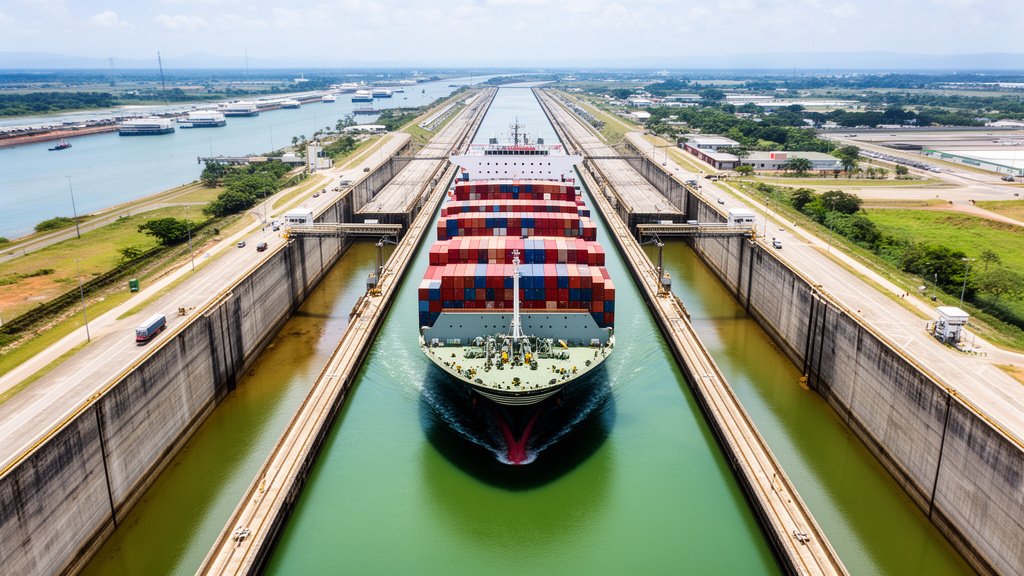
The Panama Canal Authority (ACP) has officially initiated a stringent reduction in the number of vessels permitted to transit the canal daily, a decision driven by a historic drought intensified by the El Niño-Southern Oscillation (ENSO) phenomenon. With water levels in the critical Gatun Lake plummeting, the ACP has been forced to throttle the throughput of one of the world’s most vital maritime arteries. This maneuver is not merely a regional logistical adjustment; it is a profound economic disruptor, threatening to stall cargo transit times, inflate shipping costs, and create significant bottlenecks for Caribbean ports and the broader global supply chain.
Key Highlights
- Drastic Transit Cuts: The Panama Canal Authority has reduced daily transit slots for vessels, significantly dropping from the standard capacity of 36 ships per day to levels often hovering between 24 and 27 during peak drought conditions.
- The Gatun Lake Factor: The canal relies entirely on freshwater from the Gatun Lake watershed to operate its lock system; persistent low rainfall directly correlates to reduced operational capacity.
- Global Supply Chain Ripple: The backlog of vessels waiting to traverse the canal is forcing shipping lines to reroute, leading to increased fuel consumption, longer transit times, and upward pressure on consumer prices.
- Economic Impact: Caribbean and regional ports face severe volatility as shipping schedules become unreliable, with major carriers prioritizing higher-value goods at the expense of bulk commodities.
The Hydraulic Crisis: A System at Its Limit
The Panama Canal is an engineering marvel, but it is fundamentally a freshwater-dependent system. Unlike sea-level canals that rely on tides, the Panama Canal uses a gravity-fed lock system that requires approximately 50 million gallons of fresh water to raise and lower a single vessel. This water is sourced from Gatun Lake, a massive reservoir that has been severely depleted by the record-breaking dry spell caused by the recent El Niño cycle. As water levels drop, the ACP must impose draft restrictions—limiting how deep a ship sits in the water—and reduce the number of daily transits to conserve the remaining water for essential operations and regional water supply.
For the global shipping industry, this is a systemic shock. The ‘Panama Canal shipping reduction’ is not just a localized problem; it acts as a throttle on global trade. Neopanamax vessels, which were the primary driver for the canal’s recent multi-billion dollar expansion, are the most heavily impacted by these draft restrictions. When a ship cannot be loaded to its maximum capacity, carriers are forced to either leave cargo behind or pay exorbitant premiums to bid on the few remaining transit slots, which have recently been auctioned for record-shattering prices.
Economic Shockwaves and the Caribbean Corridor
The ripple effects of these restrictions are acutely felt in the Caribbean and along the U.S. East Coast. Major logistics hubs in the region, which serve as transshipment points for goods traveling between Asia and the Americas, are witnessing a recalibration of traffic flows. Carriers are increasingly evaluating ‘intermodal’ solutions, where cargo is offloaded at one side of the isthmus and transported by rail across the country to be re-loaded on the other side, bypassing the canal locks entirely. While this keeps goods moving, it drastically increases the cost of logistics, costs that are inevitably passed down to the consumer in the form of higher prices for electronics, retail goods, and agricultural products.
Furthermore, the unpredictability of transit schedules has made ‘just-in-time’ manufacturing models untenable for many corporations that rely on predictable arrival times. The resulting uncertainty forces companies to carry higher inventory buffers, effectively locking up capital and slowing down the velocity of global commerce. For the Caribbean port sector, the long-term impact is a double-edged sword: while the canal’s congestion may drive short-term demand for regional transshipment services, the overall decline in canal efficiency risks dampening the total volume of goods moving through the hemisphere.
Strategies for a New Reality: Adaptation and Mitigation
The ACP is not standing still. Facing a new climate reality, the authority is aggressively exploring long-term mitigation strategies. These include the potential development of new water reservoirs and the implementation of advanced water-saving technologies in the lock basins, such as cross-filling mechanisms that recycle water during transit. However, these are multi-year capital projects that offer little relief to the current market volatility.
In the short term, the industry is pivoting toward digital logistics optimization. Shipping conglomerates are utilizing advanced AI forecasting to better predict water levels and plan vessel drafts weeks in advance. By optimizing the weight and buoyancy of every ship, carriers aim to maximize the amount of cargo that can traverse the canal despite the restrictive draft limits. This ‘precision shipping’ era is a direct result of the drought, forcing maritime operators to abandon the ‘fill it to the brim’ mentality of the past decade.
The Future of Global Maritime Trade
The vulnerability of the Panama Canal underscores a broader, uncomfortable truth about the 21st-century global economy: climate change is now a primary variable in logistical planning. The El Niño-fueled drought has exposed the fragility of a system that was built on the assumption of abundant freshwater. As international trade continues to grow, the reliance on single-point chokepoints like Panama, the Suez, or the Strait of Malacca, becomes increasingly risky.
Experts are now predicting a permanent shift in how shipping lines value route diversity. We are likely to see a permanent increase in investment toward ‘land bridges’—rail and road infrastructure that connects major ports—as a reliable, climate-resilient alternative to water-based transit. For the global economy, the lesson is clear: the Panama Canal’s current crisis is a harbinger of a future where climate resilience is just as critical as port capacity or ship size. The era of ‘business as usual’ for the Panama Canal has concluded; the era of adaptive, climate-conscious maritime management has arrived.
FAQ: People Also Ask
How long will the Panama Canal restrictions last?
Restrictions depend heavily on rainfall patterns and the dissipation of the current El Niño weather cycle. While the ACP continuously updates its guidance based on reservoir levels, environmental experts suggest that drought conditions could continue to affect water security in the Gatun Lake watershed for several months to years, depending on long-term climate trends.
Can ships use other routes to avoid the Panama Canal?
Yes, but they come at a cost. Ships can divert to the Suez Canal (adding weeks to the journey for many routes), navigate around the southern tip of South America (Cape Horn), or utilize land-bridge rail options across the U.S. or Mexico. All these alternatives are generally more expensive and time-consuming than the Panama route.
How does this affect consumer prices?
When shipping costs rise—either through canal auction fees, longer travel times, or the need for multi-modal transport—these costs are typically passed through the supply chain. Consumers may see increased prices for imported goods, particularly those originating from Asia destined for the U.S. East Coast, as the total cost of moving each shipping container increases.