
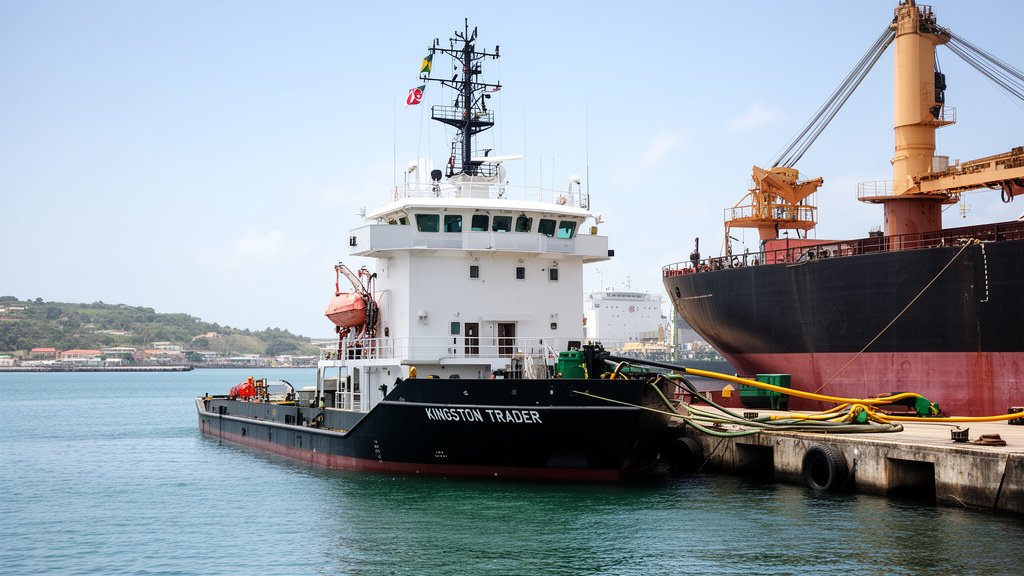
In a significant leap for the Caribbean maritime sector, TFG Marine has officially deployed the first bunker barge in Jamaica equipped with a Coriolis mass flow meter (MFM) system. This move marks a pivotal shift toward transparency and precision in local refueling operations. By outfitting the vessel ‘Kingston Trader’ with this advanced measurement technology, TFG Marine—working in tandem with its local partner, Scott Petroleum—is effectively tackling the long-standing industry challenge of bunker quantity disputes.
The Mechanics of Trust: Coriolis Technology
At the heart of this deployment is the Coriolis mass flow meter (MFM), a device widely considered the gold standard in the global bunkering industry. Unlike traditional volumetric measurement methods, which are susceptible to errors caused by temperature fluctuations, entrained air, and density variations, the Coriolis MFM measures the mass of the fuel directly.
This technology operates on the principle of the Coriolis effect, where the fluid passing through an oscillating tube causes a phase shift that is directly proportional to the mass flow rate. For ship operators, this provides an unprecedented level of certainty. In the historically murky waters of fuel bunkering, where small discrepancies in volume can translate into thousands of dollars in losses for shipping lines, the MFM acts as an impartial arbiter. By eliminating manual gauging, the technology ensures that the fuel quantity delivered is exactly what the supplier claims, leaving virtually no room for error or manipulation.
Strategic Importance of the Kingston Trader
The selection of the ‘Kingston Trader’ to house this technology is strategic. Jamaica is geographically positioned as a vital hub for vessels navigating between North America and the Panama Canal. As global shipping lanes become increasingly congested, the efficiency of port turnarounds is paramount. When a vessel enters the Port of Kingston, the speed and accuracy of bunkering can determine whether a ship meets its next delivery window or faces costly delays.
By ensuring that the fuel delivery is precise and indisputable, TFG Marine and Scott Petroleum are not only protecting the economic interests of the shipowners but are also enhancing the overall reputation of Jamaica as a premier bunkering destination. This deployment serves as a competitive differentiator, potentially drawing more international shipping traffic to the island by offering the same high-security bunkering standards found in global giants like Singapore.
Setting the New Caribbean Standard
Historically, the bunkering industry has been plagued by the ‘short delivery’ phenomenon—a reality that has frequently led to litigation and strained relations between suppliers and vessel operators. The implementation of MFM technology in Jamaica signals a maturation of the local market.
Industry analysts suggest that this move could catalyze a domino effect across the Caribbean. As shipowners increasingly demand MFM-certified deliveries to manage their operating costs and maintain strict compliance with environmental regulations—which often require precise fuel consumption reporting—suppliers who lack this technology may find themselves at a disadvantage. By adopting this standard now, the TFG Marine and Scott Petroleum partnership is positioning itself at the vanguard of a broader regional shift toward total bunker transparency.
Economic Implications and Future Scalability
Beyond the technical benefits, there is a clear economic argument for this investment. Eliminating disputes saves time and legal costs for all parties involved. A standardized, high-trust bunkering environment allows for faster fuel invoicing and settlement, streamlining the cash flow for port operations.
Furthermore, as the maritime industry faces mounting pressure to decarbonize, the data provided by mass flow meters serves a dual purpose. It provides the high-fidelity data required to monitor fuel consumption patterns, which is a critical first step in optimizing voyages for lower emissions. The ‘Kingston Trader’ is, therefore, not just a refueling vessel; it is a platform for data-driven maritime operations in the Jamaican theatre. As TFG Marine scales this initiative, the potential to integrate these meters across a wider fleet suggests that the ‘Kingston Trader’ is merely the proof-of-concept for a more technologically robust maritime future in the region.
FAQ: People Also Ask
1. Why is a Coriolis Mass Flow Meter (MFM) better than traditional methods?
Traditional volume-based methods are sensitive to temperature and air content, which can artificially inflate or deflate the apparent volume of fuel. Coriolis MFMs measure the actual mass of the liquid, providing an accurate, consistent measurement regardless of the fuel’s temperature or density, making it virtually impossible to manipulate.
2. Will this affect the price of bunker fuel in Jamaica?
While MFM technology requires capital investment, it reduces the costs associated with commercial disputes, legal challenges, and the inefficiencies of manual gauging. Over time, it creates a more reliable and cost-effective bunkering environment that attracts more business to the region.
3. Is this technology now mandatory in Jamaica?
While this deployment represents a voluntary upgrade to modern standards, it is likely that successful initiatives like this will set a market benchmark. As more shipowners demand MFM-certified deliveries, suppliers across the region will be pressured to adopt the technology to remain competitive.
4. What role does Scott Petroleum play?
Scott Petroleum acts as the local strategic partner in this venture. Their local expertise, combined with TFG Marine’s global technical capabilities and supply network, allows for the successful integration of advanced bunkering tech into the Jamaican maritime ecosystem.