
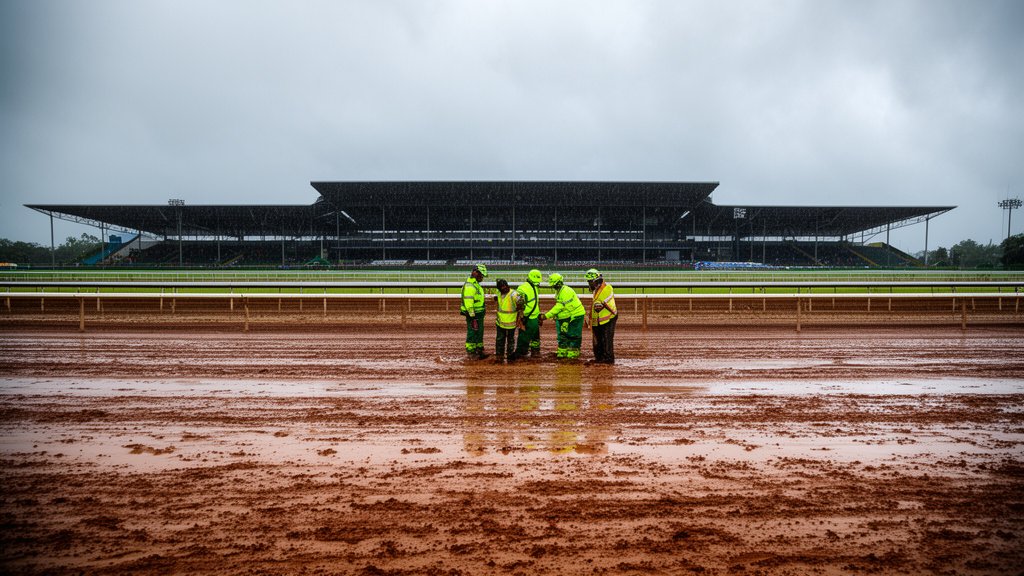
Horse racing at Caymanas Park was abruptly halted this past Saturday as severe weather conditions rendered the racing surface unsafe, forcing the cancellation of the final two races on the 10-race card. The decision, reached collaboratively between race stewards and the Jamaica Jockeys’ Guild, highlights the sport’s increasing prioritization of animal welfare and rider safety in the face of unpredictable, severe tropical weather patterns.
Key Highlights
- Safety Protocol Invoked: Racing officials and the Jockeys’ Guild jointly halted the 10-race card after the 8th race due to deteriorating track conditions caused by heavy rainfall.
- Risk Mitigation: The decision was taken to protect the integrity of the sport and, more crucially, the physical safety of the jockeys and their mounts.
- Immediate Response: The cancellation resulted in the abandonment of the final two scheduled races, triggering standard protocols for bet refunding and pool adjustments.
- Regulatory Oversight: The Jamaica Racing Commission and track management, Supreme Ventures Racing and Entertainment (SVREL), continue to monitor the track surface integrity for future events.
The Anatomy of an Abandonment
The decision to abandon racing at Caymanas Park—Jamaica’s premier horse racing venue—is never taken lightly. When the weather turns severe, as it did this past Saturday, the decision-making process shifts from race promotion to risk management. The track surface at Caymanas, a dirt-based circuit, reacts significantly to high volumes of rainfall. When the drainage systems are overwhelmed, the soil composition shifts, creating uneven footing that can lead to catastrophic slipping or injury during high-speed maneuvers.
The Intersection of Stewards and Jockeys
In this instance, the Jamaica Jockeys’ Guild played a pivotal role. Modern racing protocols grant jockeys substantial agency in assessing the safety of the ground they are riding on. Unlike eras past, where riders were often pressured to compete regardless of external conditions, today’s regulatory environment mandates a ‘safety-first’ consensus. The stewards, acting as the neutral arbiter of race day proceedings, cross-referenced the jockeys’ concerns with track inspectors’ reports. When it became evident that the track could no longer provide the necessary traction for a horse galloping at 35–40 miles per hour, the decision to abandon the remaining two races became the only responsible outcome.
The Environmental Reality of Tropical Racing
Operating a racing facility in a tropical climate requires constant vigilance regarding track maintenance. Dirt tracks, while resilient, rely on a delicate balance of moisture content. Too dry, and the surface becomes ‘hard,’ jarring the limbs of the horses; too wet, and it becomes ‘slop’ or ‘mud,’ where the lack of cohesion increases the risk of ‘breakdowns’—the racing term for serious musculoskeletal injuries. On Saturday, the sheer volume of rainfall saturated the track beyond the threshold of safety, rendering standard grooming equipment ineffective. This is a recurring challenge for SVREL, which must constantly invest in drainage infrastructure to keep pace with increasingly intense weather systems impacting the Caribbean region.
Economic and Social Ripple Effects
Beyond the immediate logistical scramble of clearing the track, the abandonment has a ripple effect throughout the local sporting economy. Caymanas Park is a hub of economic activity, supporting not just the racers, but trainers, grooms, stable staff, and the betting public. When a race card is cut short, it disrupts the flow of the betting pools—specifically the exotic wagers like Trifectas, Superfectas, and Pick-6 pools that require the completion of specific race sequences.
For the betting public, the abandonment triggers specific payout rules. Usually, this involves a ‘no-race’ declaration for the canceled events, leading to refunds or the redistribution of pools depending on the type of wager. While these measures ensure fairness, they underscore the frustration of punters who lose their window of opportunity. However, the industry consensus is increasingly moving toward accepting these cancellations as a necessary cost of modern, humane racing standards.
The Future of Track Safety Infrastructure
Looking ahead, the incident on Saturday raises questions about future capital investment in Caymanas Park’s physical plant. As climate patterns become more volatile, the pressure on track operators to install high-speed drainage solutions and potentially transition toward synthetic surfaces—which are generally more resistant to weather-related degradation—will likely mount. While synthetic tracks are expensive and alter the ‘character’ of racing, the trade-off is consistent performance regardless of rainfall.
For now, the focus remains on the immediate recovery of the track surface. The maintenance crews at Caymanas will be tasked with rehabilitating the dirt surface, grading, and testing for ‘cupping’ (where the surface gets pushed up by hooves) before the next scheduled race meet. This incident serves as a stark reminder that in the high-stakes world of horse racing, nature remains the ultimate arbiter, and the health of the athlete—both human and equine—must always occupy the winner’s circle.
FAQ: People Also Ask
Q: What happens to my bets if races are abandoned?
A: Generally, if a race is abandoned after wagering has opened but before the race is run, the bets are considered void. Depending on the betting platform and local regulations (under the Jamaica Racing Commission), your stake is typically refunded to your account or returned in cash at the track. Always check the specific house rules of the betting operator for ‘no-race’ scenarios.
Q: Who makes the final decision to cancel races?
A: The final decision rests with the Board of Stewards. They synthesize information from track inspectors, the maintenance crew, and the input provided by the Jockeys’ Guild. It is a collective decision-making process designed to ensure the sport remains within the bounds of established safety protocols.
Q: Does heavy rain always result in cancellation?
A: Not necessarily. Racing can often continue in light rain, provided the track drainage systems are managing the moisture correctly and the surface remains firm enough for safe competition. Cancellation only occurs when the track surface reaches a point of saturation that jeopardizes the traction and stability of the horses.
Q: Will the canceled races be rescheduled?
A: The rescheduling of canceled races depends on the racing calendar and the availability of the horses. Often, races are not rescheduled but are instead removed from the record for that specific card, with horses re-entered in future race meetings scheduled later in the season.