
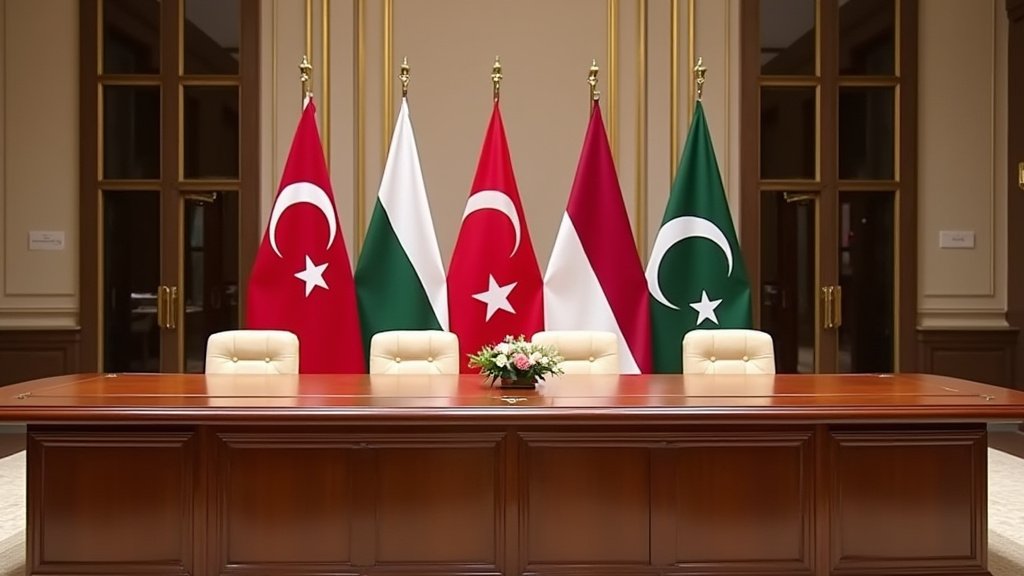
In a decisive move that reshapes regional security dynamics across the Middle East, Central Asia, and the Indo-Pacific, Türkiye, Qatar, Indonesia, and Pakistan have officially signed the ‘Badr memorandum’ in Doha. This defense cooperation pact creates a strategic quadrilateral of influence, prioritizing military interoperability, shared intelligence, and localized defense industrial development among the four signatory nations. By formalizing this agreement, the involved states are positioning themselves to act as a unified bloc capable of addressing modern asymmetric threats without total reliance on traditional Western defense architectures.
Key Highlights
- The Badr Memorandum: A newly ratified defense cooperation agreement signed in Doha aimed at deepening strategic partnerships.
- Scope of Cooperation: The pact covers joint military exercises, defense technology transfer, and intelligence sharing among the signatories.
- Strategic Rationale: A collective move toward defense industrial autonomy, reducing reliance on external suppliers for critical military hardware.
- Geopolitical Reach: The alliance links the Mediterranean and the Persian Gulf with the Indo-Pacific, creating a unique cross-continental security corridor.
The Strategic Architecture of the Badr Accord
The signing of the Badr memorandum is not merely a diplomatic formality; it is the manifestation of a long-gestating desire for strategic autonomy among emerging and established regional powers. By uniting the distinct capabilities of Türkiye, Qatar, Indonesia, and Pakistan, the Badr accord establishes a framework that is greater than the sum of its parts. Each nation brings a unique asset to the table: Türkiye provides advanced drone technology and NATO-standard manufacturing expertise; Qatar offers significant financial and logistical backing; Indonesia provides critical maritime access and the largest defense market in Southeast Asia; and Pakistan contributes a deeply experienced military industrial base and nuclear-armed security credentials.
The Industrial Integration Pivot
At the heart of the Badr memorandum is the promise of cross-pollination in defense manufacturing. For years, Turkey has surged forward with its indigenous defense programs—notably the Bayraktar TB2 and Akinci unmanned aerial vehicles. Integrating these platforms into the operational doctrines of Indonesia and Pakistan represents a shift away from the traditional, often restrictive, procurement cycles of Western-made weaponry. Under the framework of this pact, we are likely to see the establishment of joint production facilities. This is not simply about buying equipment; it is about localizing the production chain. By sharing intellectual property and manufacturing protocols, these four nations aim to insulate themselves from political volatility that often leads to arms embargoes or delivery delays. The Badr memorandum effectively creates a closed-loop ecosystem for defense tech, ensuring that these nations can maintain operational readiness regardless of changing tides in Washington, Brussels, or Moscow.
Maritime Security and the Indian Ocean Corridor
The inclusion of Indonesia and Pakistan in this bloc is particularly telling regarding maritime strategy. With Indonesia commanding key chokepoints in the Malacca Strait and Pakistan’s proximity to the vital energy transit routes of the Arabian Sea and the Persian Gulf, the Badr accord has significant implications for global maritime security. The pact is expected to formalize naval coordination, likely involving joint patrol exercises designed to secure these critical lanes against piracy, smuggling, and gray-zone threats. As global shipping becomes increasingly vulnerable to geopolitical tensions, this coalition provides a counter-narrative of security stability. By aligning their naval doctrines, these nations are signalling that they intend to be the primary guarantors of security in their respective maritime zones, asserting their sovereignty in the face of broader global power competition.
Geopolitical Hedging in a Multipolar World
Perhaps the most important aspect of the Badr memorandum is its function as a tool of strategic hedging. None of the signatory nations are severing ties with other international alliances, but they are clearly diversifying their portfolio. This move allows them to hedge against future uncertainties. For Pakistan and Türkiye, maintaining the Badr alliance ensures they are not solely dependent on established security frameworks that have often been characterized by transactional, and sometimes fickle, relationships. For Qatar, this is a method of projecting soft power by embedding itself into a broad, multi-nation military framework. This is a classic “hedging” strategy: maximizing security options by building a robust, non-aligned coalition that offers a buffer against the pressures of the Great Power competition between the U.S., China, and Russia. It marks the rise of the “middle powers”—nations that, by aggregating their resources, can influence global security outcomes far beyond what any could achieve individually.
Future Trajectories: What to Expect Next
In the coming 12 to 24 months, observers should look for three specific indicators of the pact’s success: the establishment of a permanent, multi-national secretariat for Badr operations; the commencement of the first joint, large-scale combined arms exercise involving all four nations; and the announcement of a joint venture for the production of medium-altitude long-endurance (MALE) UAVs or maritime surveillance platforms. If these milestones are met, the Badr memorandum will transition from a political agreement into an operational reality. The success of this alliance will ultimately depend on the ability of the signatories to resolve technical interoperability issues and maintain political cohesion despite their diverse internal policies. However, the initial momentum is strong, and it signals a departure from the post-Cold War order toward a future characterized by flexible, regional, and interest-based coalitions.
FAQ: People Also Ask
Q: What is the primary goal of the Badr memorandum?
A: The primary goal is to formalize defense cooperation among Türkiye, Qatar, Indonesia, and Pakistan, focusing on technology transfer, intelligence sharing, and joint military exercises to bolster regional security and defense autonomy.
Q: Does this pact replace the existing alliances of these nations?
A: No, the Badr memorandum is designed as a complementary framework. The signatory nations maintain their existing alliances, but this pact provides an alternative, flexible layer of security cooperation that reduces total reliance on any single international security architecture.
Q: Which specific military technologies are likely to be prioritized?
A: While the specific details are classified, analysts expect the prioritization of unmanned aerial vehicles (UAVs), cyber-security intelligence, maritime patrol capabilities, and joint training protocols for special operations forces.
Q: Is this an offensive military alliance?
A: The signatories have framed the Badr memorandum strictly as a defense-oriented cooperation agreement aimed at stability, deterrence, and regional self-reliance, rather than as an offensive alliance targeting any specific third-party nation.