
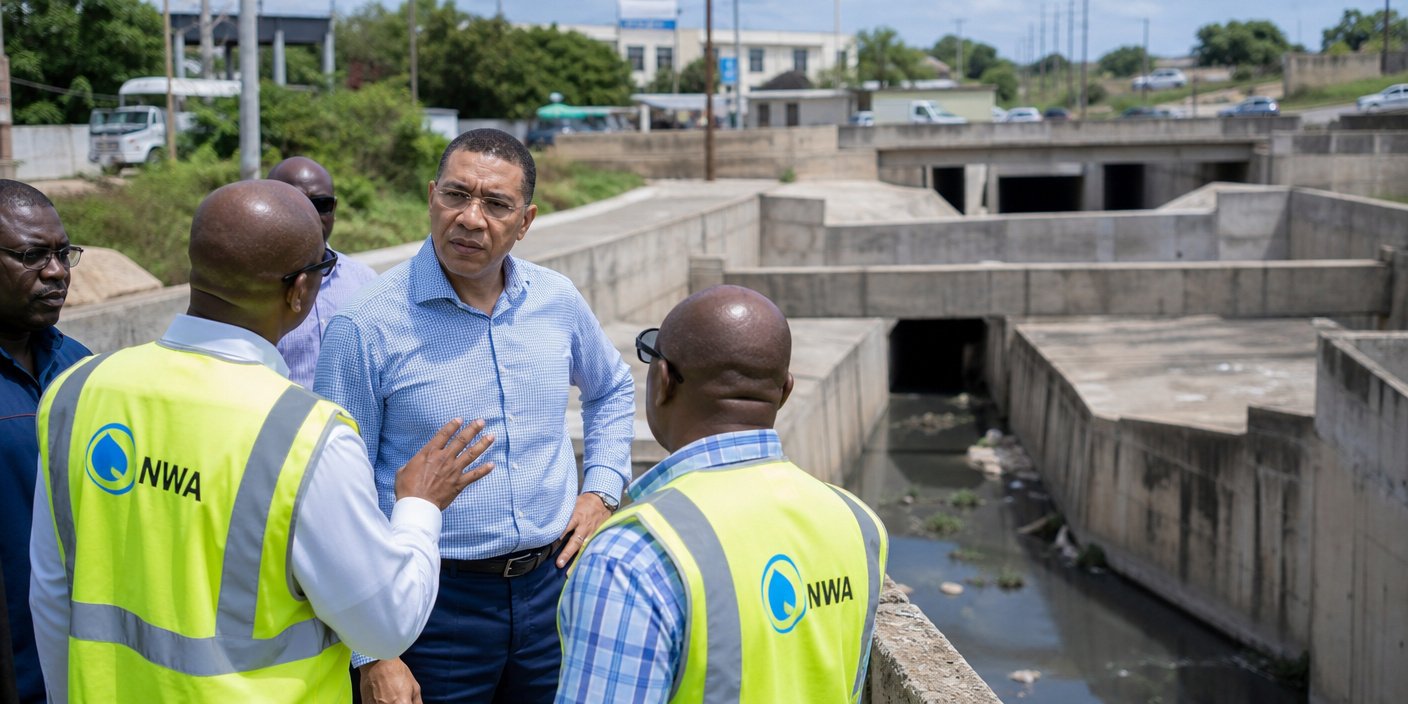
Prime Minister Andrew Holness has officially announced a high-stakes pilot programme aimed at reclaiming critical 20-foot reservation buffer zones along gullies throughout Kingston. This initiative, designed to bolster the city’s resilience against extreme weather events, directly addresses the growing conflict between informal residential density and the need for essential infrastructure maintenance. By enforcing these legal buffer zones, the government intends to facilitate the use of heavy equipment necessary for routine dredging and structural reinforcement, while simultaneously relocating residents currently living in high-risk zones.
Key Highlights
- The 20-Foot Mandate: The government is strictly enforcing a 20-foot reservation buffer zone along gully banks, a legal standard required for the operation of heavy machinery like backhoes and excavators.
- Risk Mitigation: The pilot program specifically targets the relocation of families residing in high-risk, informal settlements along drainage paths to prevent tragedy during severe storm surges.
- Infrastructure Access: The primary technical goal is to restore full access for the National Works Agency (NWA) to clean and stabilize gullies, which are the city’s primary defense against catastrophic flash flooding.
- Pilot Phase: This initial implementation serves as a blueprint for a broader, nationwide strategy to reclaim municipal drainage systems and upgrade urban water management.
The Strategic Reclamation of Kingston’s Drainage Networks
For decades, the issue of informal settlements along Kingston’s gully network has presented a complex dilemma for Jamaican urban planners and disaster management officials. Gullies, which serve as natural and man-made watercourses, are the lifeline of the city’s drainage strategy. However, the encroachment of housing units—some makeshift, others solidified over time—has rendered many of these channels inaccessible to the heavy machinery required for routine maintenance. The announcement by Prime Minister Andrew Holness marks a pivot toward a more proactive stance on disaster risk reduction.
Why the 20-Foot Buffer is Non-Negotiable
The specification of a 20-foot buffer zone is not arbitrary; it is an engineering necessity. When the National Works Agency (NWA) attempts to clear a gully of silt, solid waste, and debris, they require significant physical space for the boom of an excavator or the path of a front-end loader. Without this 20-foot clearance, large sections of the gully network remain effectively unmaintained. In the event of a hurricane or heavy tropical depression, these clogged channels overflow, leading to rapid, high-velocity flooding in the surrounding communities. This pilot programme prioritizes public safety by ensuring that the physical infrastructure can be maintained to design capacity, effectively lowering the flood risk profile for entire neighborhoods.
The Human Element: Relocation and Housing Policy
The most sensitive aspect of this reclamation effort is the relocation of residents. Many families have lived in proximity to these gullies for generations, often due to a lack of affordable housing alternatives in the Kingston Metropolitan Area. The government’s approach implies a coordinated effort with agencies like the Office of Disaster Preparedness and Emergency Management (ODPEM) and the Ministry of Economic Growth and Job Creation to ensure that relocation is not just a displacement but an integration into safer housing environments.
This policy requires a delicate balance. On one hand, the state has a duty of care to protect citizens from predictable environmental hazards. On the other, the social implications of removing long-term residents are profound. The pilot programme is designed to test the mechanisms for identification, assessment, and resettlement, aiming to minimize social disruption while maximizing the structural integrity of the drainage network.
Climate Resilience and Urban Engineering
As the Caribbean faces increasingly unpredictable weather patterns, the maintenance of gray infrastructure—roads, drains, and bridges—becomes a critical economic imperative. The cost of flooding to the Jamaican economy, measured in property damage and loss of productivity, runs into billions of dollars annually. By investing in the systematic reclamation of these buffer zones, the government is not merely performing maintenance; it is engaging in long-term climate adaptation.
The integration of the Kingston and St. Andrew Municipal Corporation (KSAMC) in this pilot suggests a holistic approach to municipal governance. Moving forward, the success of this programme will likely depend on the government’s ability to maintain these cleared buffers. Historical precedents show that once cleared, gullies can be quickly re-encroached upon if municipal monitoring is not sustained. Therefore, this initiative is likely to include long-term surveillance strategies and perhaps the installation of perimeter fencing or green-space development to prevent future illegal settlement.
FAQ: People Also Ask
1. Why is the government focusing on a 20-foot reservation specifically?
This width is the minimum required distance for the National Works Agency to safely maneuver heavy earth-moving equipment. Without this space, the equipment cannot reach the gullies to remove blockages, rendering the channel prone to catastrophic failure during heavy rainfall.
2. What happens to the residents currently living within the 20-foot zone?
The government has outlined a relocation process as part of the pilot programme. Residents in high-risk zones will be assessed and offered support to transition into safer, formalized housing arrangements to ensure they are no longer in the direct path of flood-related threats.
3. Is this programme only for Kingston?
The current announcement specifies this as a ‘pilot programme’ in Kingston. Success here is intended to provide a scalable model that the government can apply to other urban centers across Jamaica where gully encroachment threatens critical infrastructure.
4. Who is responsible for the actual reclamation work?
While the directive comes from the Prime Minister’s office, the execution involves collaboration between the National Works Agency (NWA), the Kingston and St. Andrew Municipal Corporation (KSAMC), and the Office of Disaster Preparedness and Emergency Management (ODPEM).