
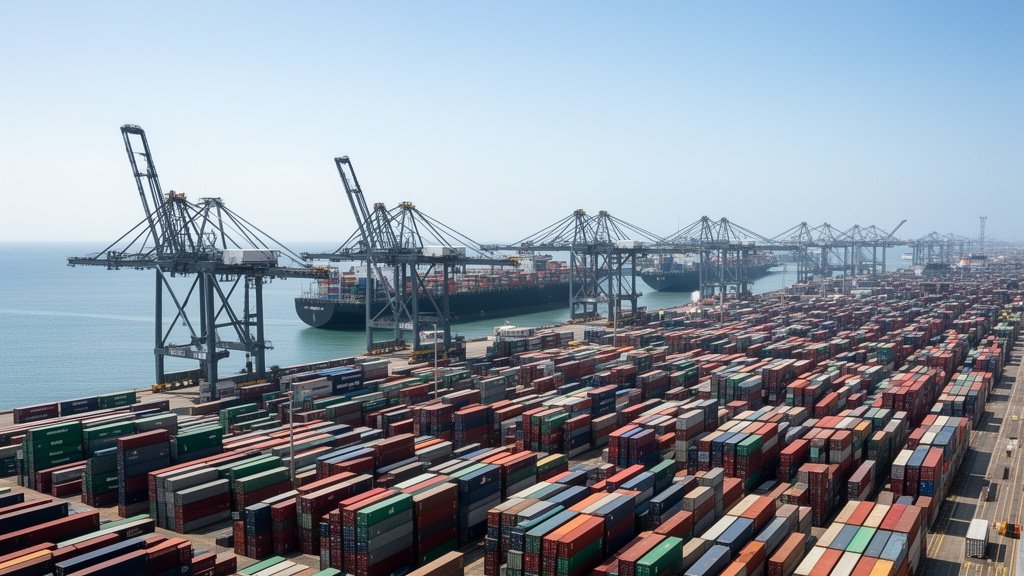
Operations at the Kingston Freeport Terminal Limited (KFTL) have ground to an absolute halt as over 1,000 dockworkers initiated a sweeping industrial action, effectively paralyzing one of the Caribbean’s most critical maritime logistics hubs. The cessation of work, which began following a breakdown in long-standing negotiations, has triggered an immediate supply chain crisis, casting uncertainty over the movement of goods entering and exiting Jamaica. The dispute, fundamentally rooted in a quest for representative autonomy, has seen workers collectively reject the current oversight of the Trade Union Congress (TUC) in favor of the Port Supervisors Union (PSU).
Key Highlights
- Total Operational Stoppage: Over 1,000 employees have walked off the job, halting all loading and unloading activities at the Kingston Freeport Terminal.
- Union Representation Dispute: The strike is driven by a strong mandate from workers to transition their collective bargaining representation from the Trade Union Congress (TUC) to the Port Supervisors Union (PSU).
- Economic Ripple Effects: As a vital transshipment hub, the KFTL stoppage threatens to backlog perishable goods and delay critical regional imports, impacting the wider Jamaican economy.
- Unresolved Workplace Grievances: While representation is the catalyst, workers have cited deeper, chronic dissatisfaction regarding stagnant pay structures and difficult workplace conditions that have persisted for years.
The Crisis at Kingston Freeport: A Hub Under Siege
The silence currently enveloping the Kingston Freeport Terminal is a stark contrast to the usual industrial cacophony of cranes, heavy machinery, and constant transit that defines this strategic gateway. For the global supply chain, which relies on the KFTL as a critical transshipment node within the Caribbean basin, this strike is not merely a local labor issue—it is a significant operational disruption. The stoppage is absolute, affecting both containerized cargo and the logistical flow essential for local business.
The Battle for Union Representation
At the core of this industrial action lies a contentious struggle for agency and voice. The workforce at KFTL has made their stance clear: they believe their current representation under the Trade Union Congress (TUC) has failed to adequately address the evolving needs of the port’s labor force. By pushing for a shift to the Port Supervisors Union (PSU), the workers are signaling a demand for a more responsive, aggressive, and granular approach to collective bargaining. This move represents a shift in labor dynamics within Jamaica, where workers are increasingly challenging established union hierarchies that they perceive as disconnected from the shop floor’s day-to-day realities.
Beyond the Union: Economic and Workplace Pressures
While the change in union representation is the primary trigger, it is the symptom of a deeper malaise. The workers have articulated that this strike is about more than just which union holds the bargaining table; it is about pay equity, compensation for the high-intensity nature of port operations, and long-standing frustrations with management during negotiations. For years, there has been simmering tension regarding how workplace improvements are communicated and implemented. The current strike acts as a pressure valve, releasing years of frustration that have accumulated despite previous attempts at arbitration or internal discourse.
The Transshipment Conundrum
Kingston Freeport is not just a domestic port; it is a regional engine. As one of the deepest natural harbors in the world, its ability to service large-scale vessels makes it a linchpin for global shipping lines. A strike of this magnitude at KFTL creates a cascading effect. When cargo ships are unable to offload, they do not simply wait; they bypass the port or redirect to competitors in neighboring territories, which leads to immediate revenue loss and long-term reputational damage for the facility. The potential for perishable goods—specifically those relying on cold chain logistics—to spoil in containers on idle ships poses a significant risk to the integrity of the supply chain.
A History of Industrial Friction
The tension currently playing out at KFTL is not an isolated event but rather a chapter in a long history of maritime labor disputes in the region. Historically, ports act as highly volatile environments for labor relations due to the critical nature of the work. When labor and management reach an impasse, the cost of the disagreement is borne by the entire national economy. The current conflict mirrors past challenges where the divide between organizational efficiency and worker welfare became irreconcilable. The move to the PSU suggests the workers are seeking a more specialized representation that understands the technicalities of port operations better than the more generalist approach offered by the TUC.
Navigating Toward Resolution
The road to recovery for KFTL operations requires a delicate negotiation strategy. Government intervention is likely necessary to facilitate a dialogue between the KFTL management, the TUC, the PSU, and the worker representatives. For resolution to occur, management must acknowledge that the traditional methods of handling labor grievances have been rendered obsolete by the workers’ demand for a change in representative structure. Simply waiting out the strike is unlikely to work, as the unified front of 1,000 workers suggests a deeply entrenched resolve that is not prone to collapsing under short-term pressure. The future of operations at the terminal will depend entirely on how swiftly and transparently these parties can move toward a new collective bargaining agreement.
FAQ: People Also Ask
Q: Why are the dockworkers specifically demanding a shift to the Port Supervisors Union (PSU)?
A: The workers feel that the PSU offers more tailored, industry-specific representation. They believe the PSU is better equipped to handle the unique technical and workplace demands of the KFTL environment compared to the broader, more generalized approach of the current Trade Union Congress (TUC).
Q: How does this strike impact the Jamaican economy?
A: The Kingston Freeport Terminal is a major transshipment hub. A total stoppage slows down the import/export flow, which can lead to supply chain bottlenecks, increased costs for local businesses, potential spoilage of perishable goods, and a loss of port revenue due to ship diversion.
Q: Is there a timeline for when operations will resume?
A: As of now, there is no official timeline for the resumption of operations. The stoppage will continue until management, the worker representatives, and the relevant unions engage in a successful, mediated negotiation to address the demands for a change in union representation.
Q: What is the primary role of the Ministry of Labour in this dispute?
A: The Ministry typically acts as the mediator in such labor disputes. They are responsible for ensuring that all parties adhere to labor laws, encouraging dialogue, and preventing the strike from causing irreversible economic damage by pushing for a swift, binding agreement.