
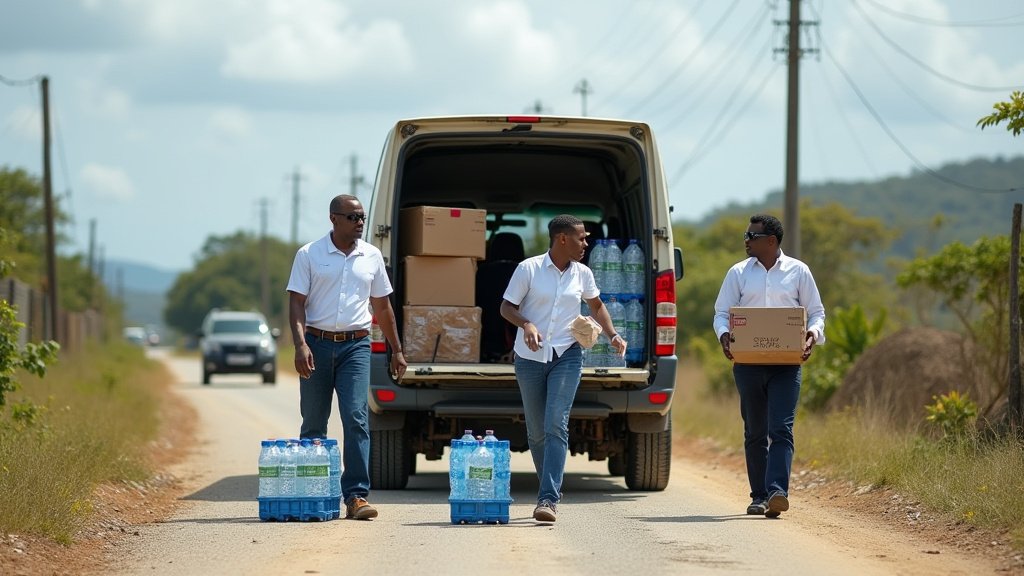
The Ministry of Labour and Social Security has initiated an immediate humanitarian response in the Trelawny community of Coopers Pen, where 44 families were left without shelter following recent, large-scale structure demolitions. As the displaced residents grapple with the sudden loss of their homes, the government has stepped in to mitigate a burgeoning social crisis, providing essential supplies, including water, food, and sanitary resources, to ensure the immediate survival and basic welfare of the affected households.
Crisis Response and Immediate Relief Efforts
The intervention by the Ministry of Labour and Social Security (MLSS) marks a critical development in the ongoing situation in Coopers Pen. Upon receiving reports of the displacement, specialized teams from the Ministry’s social services department were dispatched to the site to conduct rapid assessments. The goal was twofold: first, to establish a verifiable register of the 44 families affected, and second, to distribute life-sustaining aid. The provision of potable water and non-perishable food supplies serves as the primary stop-gap measure for families who have been uprooted from their living spaces. This humanitarian push is designed to stabilize the immediate environment, preventing secondary public health risks that often arise when dense, informal housing communities are suddenly dismantled.
The Context of the Coopers Pen Demolitions
The demolitions in Coopers Pen highlight a complex and recurring challenge within rural Jamaica: the collision between informal land occupation and the enforcement of local zoning and building codes. For many of the 44 families involved, their residences represented years of investment and stability. However, the legal environment regarding land tenure in Trelawny is stringent, often involving the Trelawny Municipal Corporation and private land claimants. When structures are deemed illegal or encroachments are identified, legal authorities are often compelled to act. This situation serves as a stark reminder of the broader national conversation regarding affordable housing, the regulation of informal settlements, and the humanitarian duty of the state to manage the fallout of property enforcement actions.
The Role of the Ministry of Labour and Social Security
The MLSS acts as the primary social safety net for the Jamaican government. In instances of disaster—whether natural, such as a hurricane, or man-made, such as widespread demolition—the Ministry is mandated to provide the ‘Emergency Relief’ component of the state’s welfare apparatus. Beyond the immediate delivery of water and supplies, the Ministry is tasked with coordinating with the Ministry of Economic Growth and Job Creation and the National Housing Trust (NHT) to evaluate the long-term prospects for the displaced. The intervention is not merely logistical; it is a signal of the government’s recognition of the human cost associated with land-use enforcement, particularly when vulnerable populations, including families with children, are displaced without a transitional housing plan.
Social and Economic Implications of Displacement
The displacement of 44 families represents a significant economic shock to the Coopers Pen ecosystem. The loss of housing often equates to the loss of physical security for assets, tools, and household documents, making the path to recovery arduous. Economically, when large groups of people are displaced, it disrupts local labor markets and education continuity for children. The government’s involvement is crucial, not only to prevent immediate suffering but to mitigate the long-term cycle of poverty that displacement frequently triggers. By providing consistent aid and potentially exploring pathways for relocation or social assistance, the authorities are working to prevent these families from falling into homelessness.
Navigating the Future: A Path to Resolution
Moving forward, the situation in Coopers Pen requires a delicate balance between respecting property rights and maintaining social cohesion. The government’s current relief efforts provide a breathing room, but they do not solve the underlying legal issues. Stakeholders are now looking to see if there will be a collaborative effort between municipal authorities and social agencies to facilitate a more sustainable outcome for these residents. This involves exploring potential land regularization where legally viable, or ensuring that those without alternatives are prioritized for state-led housing solutions. The coming weeks will be pivotal as the Ministry continues to monitor the health and wellbeing of the 44 families, ensuring that the humanitarian aid remains consistent until a more permanent resolution is identified.
FAQ: People Also Ask
Who is providing the aid to the Coopers Pen families?
The Ministry of Labour and Social Security (MLSS) is leading the humanitarian response, providing critical resources including potable water and food supplies to the 44 affected families.
Why were the demolitions in Coopers Pen carried out?
The demolitions followed enforcement actions related to land occupation and building regulations in the area. In many such cases, the Trelawny Municipal Corporation and property stakeholders enforce regulations regarding the legal status of housing structures on disputed or unauthorized land.
What long-term support is available for those displaced?
While the MLSS is focused on immediate humanitarian relief, they work in conjunction with other government entities, including the National Housing Trust and municipal planners, to assess the needs of displaced families and identify potential pathways for social assistance or housing transition.
How many families are affected by this situation?
There are 44 specific families that have been identified by the Ministry of Labour and Social Security as being displaced by the recent structure demolitions in the Coopers Pen community.