
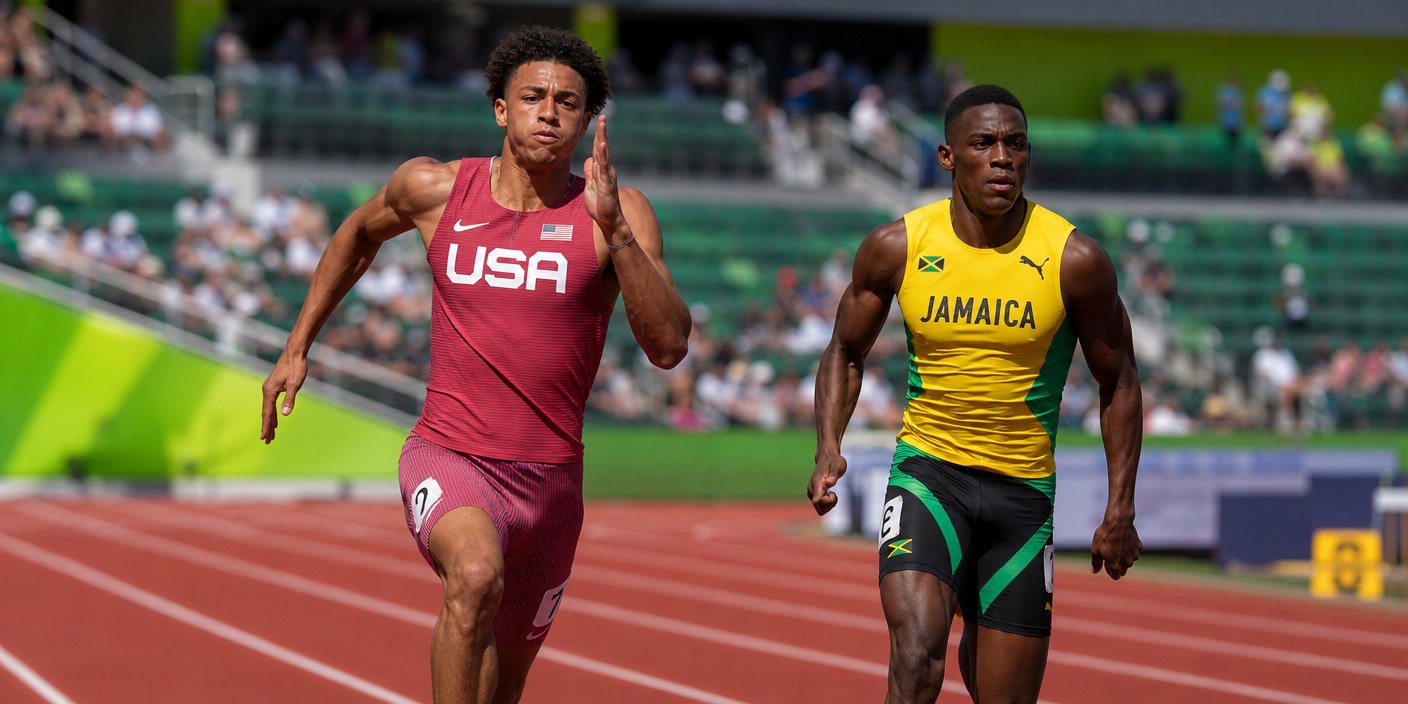
Tate Taylor has claimed gold in the men’s 100m final at the World Athletics U20 Championships 2026, marking a defining moment in his burgeoning career and officially establishing a fierce, high-stakes rivalry with Jamaica’s Gary Card. In a race decided by razor-thin margins, the atmosphere at the venue was electric, reflecting the intense build-up to what many experts are calling the most competitive U20 field in recent history. Gary Card, representing Jamaica, pushed Taylor to his absolute limit, clinching the silver medal with a highly competitive time of 10.05 seconds. This encounter is expected to be the first of many duels between two athletes who appear poised to dominate the senior circuit in the coming years.
Key Highlights
- Tate Taylor secured the gold medal in the men’s 100m final at the 2026 World Athletics U20 Championships.
- Jamaican sprinter Gary Card earned the silver medal, clocking an impressive 10.05 seconds.
- The race marked the beginning of a significant rivalry, with both athletes showcasing form far beyond their U20 classification.
- The championship, held in Eugene, served as a global stage that highlighted the depth of emerging talent in international athletics.
The Dawn of a New Sprint Era
The 100m final at the World Athletics U20 Championships is traditionally the event where tomorrow’s legends are minted. In 2026, that tradition held true, but with a unique narrative intensity that has rarely been seen at the junior level. The presence of Tate Taylor and Gary Card at the top of the podium represents a shifting of the guard. For years, the sprinting world has looked toward the next cycle of athletes to fill the void left by retiring icons, and the 2026 performance in Eugene suggests that the void is not only being filled but potentially eclipsed by a new generation of raw, refined talent.
Analyzing the 10.05 Second Sprint
Gary Card’s 10.05-second finish is a testament to the technical advancement of youth athletics. To put this time in perspective, it is a marker that historically qualifies athletes for major semi-final appearances on the senior international stage. Card’s mechanics—specifically his drive phase and transition—were flawless. Yet, it was Taylor’s ability to maintain top-end velocity in the final 20 meters that ultimately separated the two. The rivalry is not just about the medals; it is about the contrasting styles. Card relies on explosive, aggressive power, while Taylor displays a rhythmic, efficient fluidity that allows him to decelerate less than his competitors. This clash of styles is exactly what sports analysts look for when projecting a multi-year rivalry.
The Eugene Factor: A Track Capital
Eugene has long been considered the ‘TrackTown’ of the United States. Hosting the 2026 World Athletics U20 Championships in this environment provided a level of psychological pressure that U20 athletes rarely encounter. Competing in front of a knowledgeable, vocal crowd that understands the nuances of the 100m sprint accelerates the maturity of these young athletes. The track surface, the wind conditions, and the sheer scale of the stadium forced both Taylor and Card to perform under conditions that mimic the Olympic Games. The success of this event reinforces Eugene’s position as the premier host for high-stakes athletics.
Tactical Implications for the Future
Beyond the medals, the 10.05 result signals a tightening of the gap between the world’s elite sprinters and the rising U20 crop. If Card and Taylor continue on this trajectory, we can expect them to challenge for spots in the upcoming senior World Championship qualifiers. The psychological advantage gained by Taylor in this victory will be tested when he meets Card on the Diamond League circuit. Rivalries like this are the lifeblood of track and field; they drive media interest, sponsorship opportunities, and, most importantly, the training intensity of the athletes involved.
Secondary Angles
1. The Economics of the ‘Next Big Thing’
Athletes like Tate Taylor and Gary Card are no longer just athletes; they are emerging commercial entities. This result at the 2026 U20 Championships will undoubtedly trigger a scramble among athletic apparel giants to secure long-term endorsement deals. The financial implications for these young runners are immense, potentially altering their training capabilities and access to elite coaching and medical support earlier than their predecessors.
2. Psychological Resilience in Youth Athletics
We often overlook the immense mental load placed on 19 and 20-year-olds in high-performance sports. Managing the transition from ‘junior sensation’ to ‘professional adult’ is fraught with peril. This rivalry could serve as a double-edged sword: it could either sharpen their focus through healthy competition or lead to burnout if the pressure to maintain this level of performance becomes unmanageable. How they navigate the next 18 months will define their career longevity.
3. Historical Context: Tracking the 10-Second Barrier
Comparing the 2026 U20 cohort to the legends of the past offers a window into the evolution of the 100m sprint. While sub-10 seconds remains the gold standard, the consistency with which U20 athletes are flirting with the 10.00-10.05 range suggests that the sport is trending toward faster baseline times globally. The technical coaching, nutrition, and recovery technology available to these athletes are vastly superior to what was available even a decade ago.
FAQ: People Also Ask
Q: What does Gary Card’s 10.05s time signify for his future?
A: A 10.05s clocking at the U20 level is elite. It positions Card as a top-tier prospect capable of competing at the senior national level almost immediately. It suggests he has the speed-endurance to potentially break the 10-second barrier as he approaches his athletic peak.
Q: Is this the first time Tate Taylor and Gary Card have raced?
A: While they have competed at various regional youth meets, the 2026 World Athletics U20 Championships in Eugene is the first time their rivalry has reached a global scale, solidifying their status as the two main protagonists of this age group.
Q: How does the U20 Championship affect Olympic qualification?
A: While the U20 Championships do not provide direct qualification for the Olympic Games, they serve as a critical scouting ground. Performances here, like Taylor’s gold and Card’s silver, significantly impact an athlete’s world ranking and provide them with the high-stakes experience necessary to succeed in future Olympic trials.