
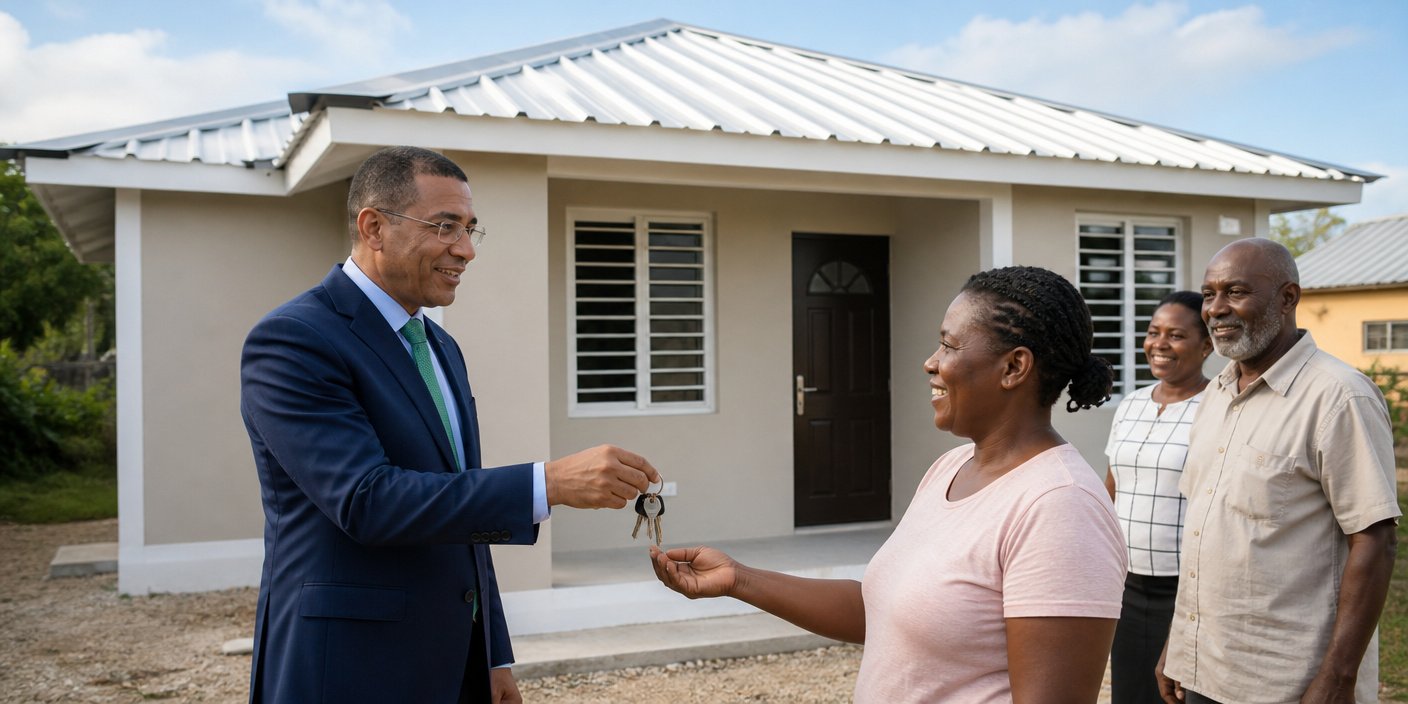
Prime Minister Andrew Holness presided over the handover of five new homes in St. James under the New Social Housing Programme (NSHP) on Friday, October 23, providing critical support to families, including those affected by recent hurricane damage. This initiative represents a cornerstone of the administration’s strategy to tackle housing informality and provide dignified living conditions for the most vulnerable citizens across the island.
Key Highlights
- Direct Intervention: Five newly constructed, modern residential units were formally handed over to beneficiaries in St. James.
- Disaster Recovery: A primary focus of this phase of the NSHP was providing immediate relief to families whose homes were compromised or destroyed by recent hurricane activity.
- Policy Alignment: The project underscores the government’s commitment to the New Social Housing Programme (NSHP), a policy designed to streamline housing support for the indigent.
- Community Stability: By securing property tenure for vulnerable residents, the government aims to foster long-term community growth and social equity.
Advancing Dignity Through Targeted Infrastructure
The handover ceremony held on Friday, October 23, serves as a high-visibility testament to the Jamaican government’s evolving approach to social welfare. Under the mandate of the New Social Housing Programme (NSHP), the Ministry of Economic Growth and Job Creation has intensified efforts to transition citizens from substandard, often hazardous housing conditions into modern, concrete-block structures that meet national building codes.
For the recipients in St. James, this transition is more than a change of address; it is a fundamental shift in their quality of life. Many of these families had been struggling in the aftermath of recent natural disasters, where hurricane-force winds and torrential rains exposed the extreme vulnerability of older, makeshift dwellings. By integrating disaster-resilience features—such as reinforced roofing and concrete foundations—into these new units, the NSHP is effectively building a buffer against future climate-related economic shocks at the household level.
The Socio-Economic Ripple Effect
Infrastructure, particularly housing, is rarely an isolated investment. When the NSHP provides a secure home, it initiates a ripple effect in local economic health. Secure, sanitary housing is the bedrock of improved health outcomes; it reduces the spread of respiratory and communicable diseases often linked to damp and overcrowded conditions. Furthermore, it provides the stability necessary for children to focus on their education and for working adults to maintain consistent employment.
In St. James, a parish known for its tourism-driven economy and its complex urban-rural divide, these homes symbolize the government’s recognition that national economic growth must be inclusive. By focusing resources on those who are historically overlooked, the NSHP acts as a mechanism to mitigate the generational cycle of poverty. The program is not merely about construction; it is about providing the physical security required for families to participate more actively in the Jamaican economy.
Resilience Amidst Climate Challenges
Jamaica’s geographical positioning makes it inherently susceptible to the intensification of Atlantic hurricane seasons. The recent damage experienced by these families was a poignant reminder of the fragility of the informal housing stock in the region. The NSHP is now effectively serving as a climate-adaptation tool. By deploying resources to replace vulnerable structures with standard-compliant units, the government is reducing the long-term fiscal burden of emergency housing and disaster relief. Each home handed over is an asset that is statistically less likely to require emergency intervention following the next weather event.
Operationalizing the NSHP Mission
The operational success of this handover relies on a collaborative framework involving the St. James Municipal Corporation, the National Housing Trust (NHT), and community-based organizations. This multi-agency approach ensures that the selection process remains transparent and that the units are placed in areas where families already have existing social networks, thus preventing the displacement of residents from their support systems. This localized approach is critical; it ensures that the NSHP does not just build houses, but continues to sustain communities.
Looking ahead, the demand for social housing in Jamaica remains substantial. However, the consistent delivery of projects like the one concluded on October 23 provides a scalable template for the Ministry. As the administration continues to refine its construction timelines and procurement processes, the goal remains clear: to eliminate the most extreme instances of housing deprivation across the island. The focus moving forward will likely involve increasing the frequency of these handovers and integrating more renewable energy solutions into these units, further lowering the cost of living for low-income beneficiaries.
FAQ: People Also Ask
What is the New Social Housing Programme (NSHP)?
The NSHP is a government initiative launched to provide decent, dignified, and sustainable housing solutions for the most vulnerable citizens, specifically those who cannot afford traditional mortgages or housing solutions.
How are beneficiaries selected for these homes?
Beneficiaries are typically selected through a rigorous assessment conducted by the Ministry of Economic Growth and Job Creation in coordination with local municipal bodies, ensuring the aid reaches those in the most urgent need, such as the elderly, the disabled, or victims of natural disasters.
Are these homes free for the recipients?
The NSHP is designed as a welfare-based initiative. The homes are provided as grants to qualifying families, allowing them to gain security of tenure without the burden of repayment, which is essential for alleviating poverty.
Will the NSHP continue to expand in St. James?
Yes, the government has signaled that the NSHP is a long-term commitment. Given the need in St. James, further assessments are ongoing to identify other households that meet the strict criteria for future phases of the programme.