
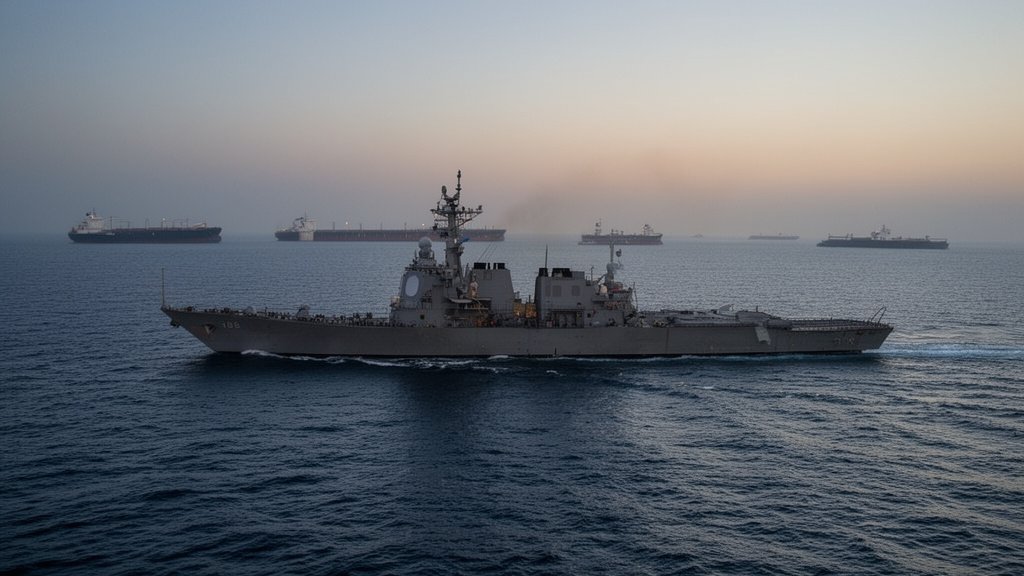
Tensions in the Middle East have reached a critical inflection point on October 15 as U.S. military planners reportedly evaluate the potential deployment of the GBU-43/B Massive Ordnance Air Blast (MOAB) bomb to address Iranian nuclear infrastructure. This strategic pivot coincides with a deteriorating maritime security situation, confirmed by the sinking of two commercial cargo ships near the Strait of Hormuz. The convergence of these events marks a dramatic increase in regional volatility, effectively ending diplomatic ambiguity and forcing international observers to prepare for the possibility of kinetic military operations.
Key Highlights:
- U.S. Strategic Consideration: The Pentagon is reportedly finalizing contingency plans involving the GBU-43/B, the largest non-nuclear weapon in the U.S. arsenal, for precision strikes against fortified Iranian nuclear facilities.
- Maritime Crisis: Two cargo vessels have been confirmed sunk in the Strait of Hormuz, one of the world’s most vital energy transit choke points, amid a spike in regional hostility.
- Regional Destabilization: The combination of the sinking ships and the threat of heavy ordnance usage has triggered high-level security alerts across the Persian Gulf, raising concerns over global oil supply chain integrity.
The Strategic Calculus: MOAB and Maritime Risks
The potential use of the GBU-43/B—the Massive Ordnance Air Blast (MOAB)—represents a fundamental shift in U.S. military posture regarding Iran. Known as the “Mother of All Bombs,” the weapon is a 21,600-pound (9,800 kg) GPS-guided thermobaric munition. Its primary function is to destroy hardened, deeply buried, or tunnel-complex targets through massive blast overpressure. Unlike conventional bunker busters designed for penetration, the MOAB is designed to incinerate oxygen within a massive blast radius, collapsing tunnel systems and neutralizing threats that traditional munitions might fail to reach. Intelligence reports suggest that U.S. planners are reviewing these assets as a “message of capability” to the Islamic Revolutionary Guard Corps (IRGC), signaling that the U.S. has the technical means to neutralize deep-underground nuclear enrichment facilities without requiring a tactical nuclear exchange.
The Strait of Hormuz: A Vital Chokepoint in Peril
The sinking of two cargo ships near the Strait of Hormuz is not merely a regional maritime incident; it is a direct assault on the global economic order. The Strait, through which roughly 20% of the world’s petroleum liquids pass daily, remains the most significant oil transit corridor on the planet. The loss of these vessels suggests a deliberate “grey zone” tactic, likely intended to test the naval response times of the U.S. Fifth Fleet and its coalition partners. Analysts at U.S. Central Command (CENTCOM) are currently assessing whether these sinkings were the result of sea mines, drone-delivered munitions, or deliberate sabotage by IRGC-aligned naval assets. This development forces the maritime insurance industry to potentially declare the Persian Gulf a high-risk “war zone,” a move that would immediately skyrocket global energy shipping costs and create cascading inflationary pressure on international markets.
Geopolitical Ripples: Market Stability and Diplomatic Fallout
Beyond the immediate tactical implications, the dual threats of MOAB deployment and maritime disruption serve as a pressure test for the current administration’s containment strategy. Historical parallels are being drawn to the “Tanker War” phase of the 1980s Iran-Iraq conflict, where naval clashes threatened global oil supply chains for years. However, this situation is exacerbated by the modern integration of long-range ballistic missile systems and high-end drone swarms. Economic markets have reacted with sharp volatility; crude oil futures saw an immediate spike in trading as investors factored in the potential for a complete closure of the Strait of Hormuz. Diplomatic channels are currently scrambling to de-escalate; however, the visibility of the U.S. military planning regarding the MOAB indicates that the “red lines” have shifted. The narrative has moved from one of containment to one of potential “decapitation” strikes against nuclear assets, a shift that complicates any diplomatic off-ramp. Furthermore, the environmental impact of the sunken vessels—if they were carrying hazardous chemicals or fuel—remains an under-reported variable that could trigger a regional ecological disaster, further complicating naval rescue and salvage operations in the already tense waters.
FAQ: People Also Ask
Q: What is the GBU-43/B, and why is it considered a major escalation?
A: The GBU-43/B, or MOAB, is the most powerful conventional bomb in the U.S. inventory. Using it against a sovereign nation like Iran would represent a significant escalation in force, moving beyond standard precision strikes to a “shock and awe” tactic designed to destroy large-scale underground facilities.
Q: Why is the Strait of Hormuz so critical to the global economy?
A: The Strait of Hormuz is the world’s most important oil transit chokepoint. Nearly 21 million barrels of oil pass through this waterway daily, making it the central artery for global energy supply. Instability here directly impacts global fuel prices.
Q: Are there reports of casualties from the sunken cargo ships?
A: While details are still emerging from the Strait of Hormuz, initial reports from maritime tracking authorities indicate that search and rescue efforts are underway. However, the hostile environment in the region is complicating humanitarian assistance efforts.
Q: How does this impact the nuclear deal landscape?
A: The rhetoric surrounding the potential use of heavy ordnance against nuclear sites effectively renders existing diplomatic non-proliferation frameworks highly fragile, forcing nations to choose between supporting military intervention or attempting renewed, high-stakes diplomacy.