
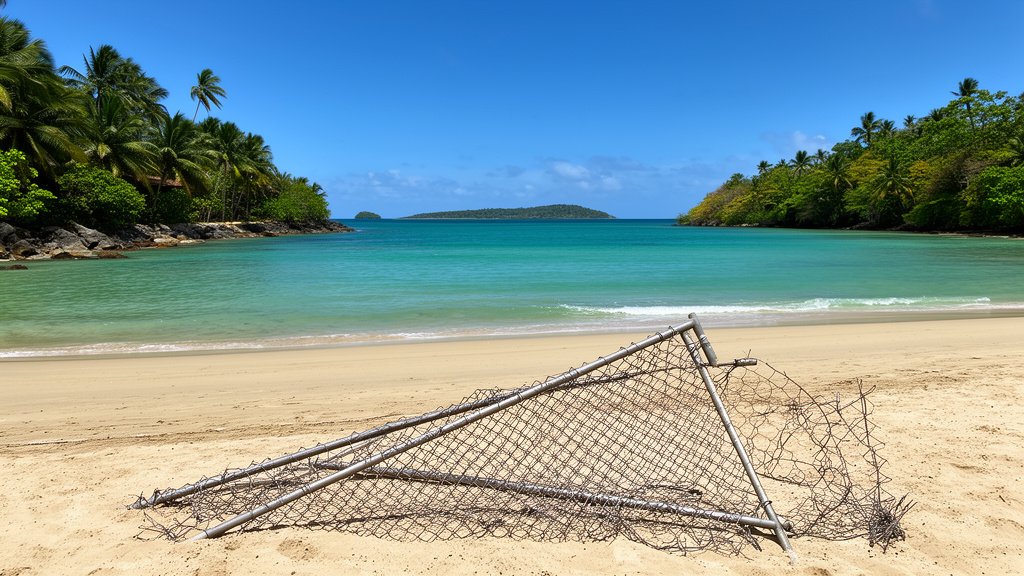
A St. Ann Parish Court judge has issued a mandatory injunction against the Urban Development Corporation (UDC), immediately restoring public access to Little Dunn’s River beach. This landmark ruling marks a significant win for the Jamaica Beach Birthright Environmental Movement (JBBEM), which has campaigned aggressively to prevent the privatization of the historically accessible shoreline. The decision halts all current obstructions, including fencing and gated closures, that prevented the local community from utilizing the popular coastal site, at least until the matter can be fully adjudicated.
Key Highlights
- Immediate Access: The court order mandates the immediate removal of all physical barriers that had effectively turned a public, natural resource into a restricted-access area.
- JBBEM Leadership: The ruling validates the strategy of the Jamaica Beach Birthright Environmental Movement, which argued that public rights of way and historical usage take precedence over commercial development plans.
- Legal Precedent: The injunction places a significant check on the Urban Development Corporation’s (UDC) authority, setting a potential precedent for other contested beach access sites across the island.
- Pending Appeal: While the injunction is a victory, it is a preliminary measure; the government and the UDC are expected to mount a legal challenge, setting the stage for a protracted courtroom battle.
The Battle for the Shoreline: Little Dunn’s River Restored
The dispute over Little Dunn’s River, a pristine strip of coastline located in the parish of St. Ann, has become the focal point of a larger, systemic debate in Jamaica regarding the ownership of natural resources. For decades, the beach has been a site of recreation for locals, providing a cost-free escape to the Caribbean Sea. However, the Urban Development Corporation (UDC)—the state agency responsible for overseeing and developing significant portions of Jamaica’s landscape—moved to restrict access as part of a broader development strategy intended to monetize the area.
The JBBEM, a grassroots coalition of environmentalists, community leaders, and concerned citizens, viewed this move as an act of “beach privatization” that disenfranchised the local population. The movement argued that the beach is a cultural and historical asset that should remain open to the public, citing longstanding usage patterns. When the UDC began erecting physical barriers, the frustration within the community culminated in organized protests and, eventually, this specific legal challenge.
The Legal Argument: Public Right vs. Development Rights
During the proceedings at the St. Ann Parish Court, the legal team representing the JBBEM presented evidence asserting that the community’s right to access the beach is not merely a custom but a right rooted in public usage that has persisted for generations. The presiding judge examined the evidence regarding the barriers and the impact on the local community’s ability to enjoy the shoreline.
The court’s decision to grant the injunction signifies that, for the time being, the harm caused by blocking access to the beach outweighs the potential development gains championed by the UDC. The injunction requires that all physical obstacles—specifically the gates and fencing installed by the UDC—be removed so that the beach can return to its state of public accessibility. This is a temporary measure, yet it carries immense symbolic and practical weight. It forces the UDC to acknowledge that public spaces cannot be arbitrarily cordoned off without adequate community consultation and a clear legal basis.
Secondary Angle: The Precedent for Jamaican Coastal Management
This case has sparked a wider conversation across Jamaica regarding coastal management. The victory for JBBEM is being closely watched by communities across other parishes where similar disputes exist between residents and developers. The central question is whether the state, via agencies like the UDC, has the mandate to prioritize foreign-direct investment and high-end tourism infrastructure at the expense of local access to the sea.
If the JBBEM succeeds in the full trial, this could signal a systemic shift in how Jamaican courts handle “public rights of way” in coastal zones. It could force the government to adopt a more collaborative approach to development, one that treats the community as a stakeholder rather than an obstacle. Conversely, an appeal by the government could lead to a drawn-out legal process that tests the limits of environmental law and public access rights in the Jamaican constitution.
Economic Impact: The Tourism Balancing Act
Critics of the court’s decision—mostly proponents of the UDC’s development plan—argue that the economic potential of the site was being stunted by a lack of proper management and facilities. They contend that the area, if developed with amenities, could generate revenue and create jobs for the local St. Ann community. However, the counter-argument, and the one that has seemingly gained traction with the court, is that “development” cannot be defined solely by commercial enterprise. The non-monetary value of social cohesion, recreation, and the preservation of natural heritage must also be quantified in the economic balance sheet. By restoring access, the community maintains its connection to the environment, preventing a scenario where locals are priced out of their own country’s most beautiful landscapes.
FAQ: People Also Ask
1. What did the St. Ann Parish Court rule regarding Little Dunn’s River?
The court granted a mandatory injunction that requires the Urban Development Corporation (UDC) to immediately remove all obstructions, such as fences and gates, which prevented the public from accessing the beach. This is a temporary ruling while the case proceeds to a full hearing.
2. What is the Jamaica Beach Birthright Environmental Movement (JBBEM)?
The JBBEM is a grassroots organization dedicated to preserving public access to Jamaica’s beaches. They act as a watchdog group, challenging government and private development projects that seek to privatize or restrict access to historically public coastal lands.
3. Is this ruling permanent?
No. The current court order is an injunction, which serves as a temporary “pause button” on the UDC’s development activities and barrier installations. The case will eventually go to a full trial where the court will decide on the merits of a permanent injunction.
4. Why did the UDC want to restrict the beach?
The Urban Development Corporation cited development plans intended to upgrade the area’s infrastructure. Their goal was to enhance the site for commercial and tourism purposes, which often involves controlled access to maximize revenue and manage facility maintenance.