
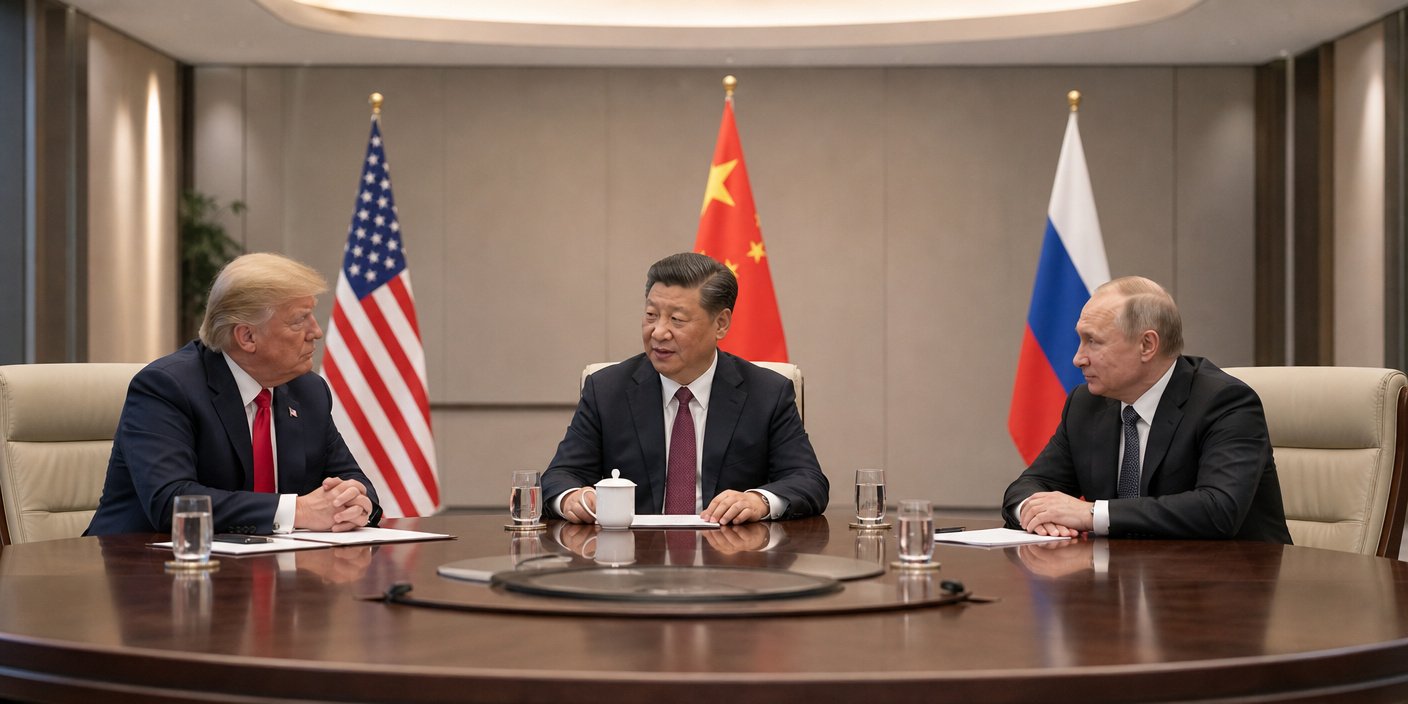
In a display of high-stakes diplomacy that has stunned the international community, U.S. President Donald Trump, Chinese President Xi Jinping, and Russian President Vladimir Putin gathered today in Shenzhen for an unprecedented three-way summit. The meeting, which marks the first time these three specific leaders have engaged in direct, trilateral negotiations, was ostensibly designed to address the crumbling foundations of global governance. While the high-level dialogue touched upon critical pillars—specifically the reform of the United Nations and the mitigation of escalating nuclear risks—the outcome underscored the profound challenges of managing a world defined by competing spheres of influence.
Key Highlights
- Nuclear Risk Management: All three powers reaffirmed the importance of maintaining communication channels to avoid accidental nuclear escalation, though no new arms control treaties were signed.
- UN Reform Negotiations: The leaders engaged in substantive discussions regarding the modernization of the United Nations Security Council, yet remained deadlocked on the implementation of structural changes.
- Geopolitical Stasis: Despite the high-profile nature of the gathering, the summit yielded no concrete breakthroughs on the major geopolitical conflicts currently destabilizing global relations.
The Shenzhen Trilateral: A New Era of Direct Diplomacy
The choice of Shenzhen—a bustling hub of global technology and a symbol of China’s rapid economic rise—as the backdrop for this historic meeting was not accidental. It served as a neutral, albeit commercially symbolic, ground for the three leaders to attempt a reset of relations that have been severely strained by conflicting interests in Europe, the Indo-Pacific, and the Middle East. The central premise of the summit was to establish a high-level “safety valve” for geopolitical friction, moving away from proxy rhetoric and toward direct communication.
The Nuclear Tightrope
One of the primary objectives of the summit was the management of nuclear risks. In an era where long-standing arms control frameworks have either expired or been abandoned, the possibility of miscalculation has reached its highest point since the Cold War. President Trump, President Xi, and President Putin reportedly discussed the need for clear “red lines” and military-to-military communication. While the rhetoric surrounding the summit emphasized stability, observers note that “managing risk” is distinct from “reducing risk.” Without the re-introduction of rigorous, transparent inspections or verifiable treaty mechanisms—which were noticeably absent from the summit’s concluding statements—the nuclear landscape remains as precarious as before.
United Nations Reform: A Distant Horizon
Perhaps the most ambitious item on the agenda was the modernization of the United Nations. All three leaders acknowledged that the current architecture of the UN Security Council is increasingly viewed as obsolete. However, their approaches to reform are diametrically opposed. Washington, Beijing, and Moscow have vastly different visions for what a “modern” UN looks like. The discussions in Shenzhen highlighted a fundamental disagreement on the balance of power: whether reform should expand democratic representation or further entrench the veto power of the existing permanent members. The summit concluded with an agreement to establish a working group to study the issue, a diplomatic move often used to defer resolution rather than achieve it.
The Geopolitical Impasse
Despite the spectacle of the meeting, the “elephant in the room” remained untouched. There were no breakthrough announcements regarding the war in Ukraine, the ongoing tensions in the Taiwan Strait, or the complex economic sanctions regimes currently driving trade wars. The leaders maintained their respective hardline stances, utilizing the summit as a platform to project strength rather than a venue for concession. The geopolitical status quo, characterized by deeply entrenched stalemates, was effectively preserved by the conclusion of the session.
Deep Dive: The Strategic Pivot
The Shift from Multilateralism to Trilateralism
The Shenzhen summit signals a potentially profound shift in global order. For decades, the international system relied on broad multilateral institutions like the G20 or the UN to manage global affairs. However, the move toward a three-way summit suggests that these leaders view “minilateralism”—exclusive, high-level clubs of powerful states—as the only effective way to negotiate the modern world. This shift prioritizes direct deal-making between the most powerful nations at the expense of smaller, less-aligned countries, potentially leaving the rest of the world to navigate the consequences of decisions made behind closed doors.
Economic Volatility and Market Reaction
Markets have reacted with cautious volatility to the news of the summit. Investors are caught between two narratives: the hope for a reduction in trade barriers that could stabilize the global economy, and the fear that this summit merely cements a “great power competition” that will eventually lead to further economic decoupling. The lack of specific, actionable trade policies from Shenzhen indicates that the global economy will remain subjected to the whims of geopolitical competition for the foreseeable future.
Historical Context: Lessons from the Past
Historians comparing this meeting to Cold War-era summits note a crucial difference: interconnectedness. Unlike the U.S.-Soviet relations of the 20th century, the U.S.-China-Russia nexus is deeply entangled through complex supply chains, digital infrastructure, and financial networks. The cost of “getting it wrong” is exponentially higher today, which may paradoxically act as a stronger deterrent against direct conflict, even as diplomatic tensions persist.
FAQ: People Also Ask
Q: Why was Shenzhen chosen for this summit?
A: Shenzhen was selected for its symbolic significance as a global engine of technology and manufacturing, serving as a neutral site that reflects the modern, interconnected nature of the global economy, away from the traditional diplomatic hubs of Washington, Beijing, or Moscow.
Q: Were there any new arms control treaties signed?
A: No. While the leaders agreed on the importance of managing nuclear risks and maintaining communication channels, no new binding treaties or specific arms reduction agreements were signed during the summit.
Q: Did the summit address the war in Ukraine or Taiwan?
A: The summit did not result in any breakthroughs regarding these specific geopolitical conflicts. The leaders maintained their existing public positions, and no concrete resolutions or concessions were reported on these sensitive issues.