
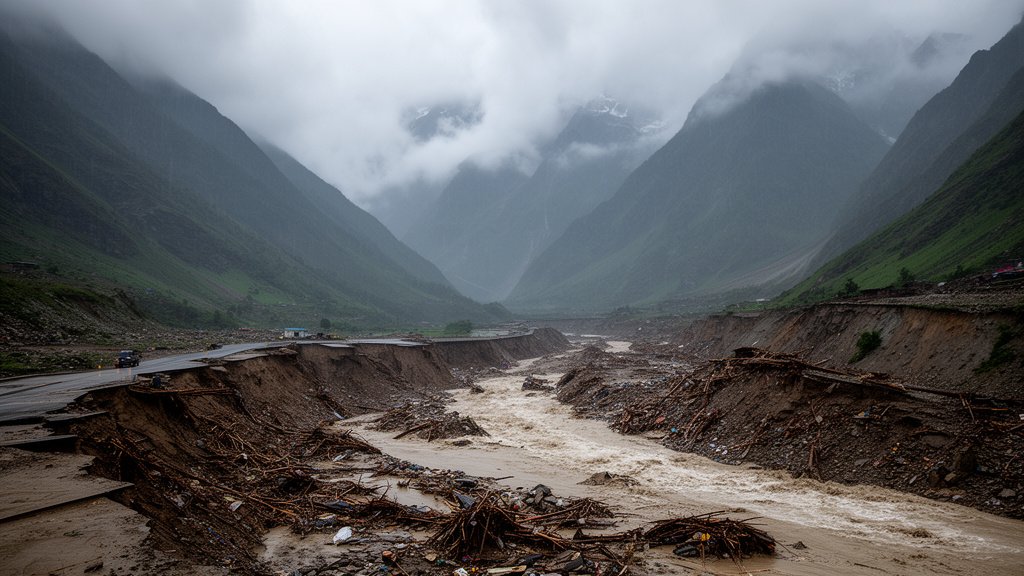
At least 62 people have lost their lives following a relentless onslaught of severe monsoon rains that have paralyzed large swaths of northern India, triggering devastating flash floods and landslides that have washed away infrastructure and disrupted thousands of households. As water levels continue to rise in critical mountain corridors, authorities and search-and-rescue teams are working against the clock to reach isolated communities, while the death toll remains a fluid and harrowing figure that officials warn could climb as recovery efforts penetrate deeper into the affected terrain.
Key Highlights
- Catastrophic Human Cost: Confirmed death toll stands at 62, with dozens more missing and injured across the most heavily impacted northern states.
- Operational Challenges: Flash floods have severed arterial highways and bridges, effectively isolating mountain villages and hindering the immediate deployment of heavy machinery for relief.
- Emergency Response: The National Disaster Response Force (NDRF) and local state authorities have mobilized, conducting air evacuations and providing temporary shelter to thousands displaced by rising waters.
- Meteorological Warning: The India Meteorological Department (IMD) maintains high-alert status, citing an active monsoon trough that is expected to continue dumping extreme precipitation for the coming 48 hours.
Anatomy of a Disaster: The Northern India Monsoon Crisis
The current humanitarian crisis unfolding across northern India serves as a stark reminder of the region’s vulnerability to aggressive climatic events during the monsoon season. What began as seasonal rainfall quickly escalated into a catastrophic deluge, catching many regions off-guard despite prior weather warnings. The human toll—currently at 62 confirmed deaths—reflects the suddenness of the flash floods, which often strike with little time for residents to seek higher ground.
Meteorological Volatility and the Monsoon Trough
At the center of this disaster is an intensified monsoon cycle. The India Meteorological Department (IMD) has been tracking a dynamic monsoon trough that has hovered over the northern mountain ranges, acting as a relentless pump for moisture. Unlike the rhythmic, steady rains of decades past, recent data points to a disturbing trend: highly compressed, high-intensity rainfall events. Within the span of a few hours, some districts have received rainfall totals that typically accumulate over weeks. This concentration of volume exceeds the saturation capacity of the soil, triggering the catastrophic landslides that have become the hallmark of this particular event. The geological composition of these Himalayan regions, already prone to instability, essentially liquefies under the pressure of such unprecedented hydrologic volume, turning hillsides into deadly debris flows that sweep away everything in their path.
Infrastructure Resilience and the Cost of Development
Beyond the immediate tragedy, there is a mounting conversation regarding the resilience of infrastructure in northern India. As the region has pushed for rapid development, including the expansion of highway networks and tourism infrastructure, the environmental impact has been profound. Many of the roads blocked or destroyed in the current floods were built along precarious mountain shelves. When flash floods hit, these routes, which serve as lifelines for supplies, medical access, and evacuation, are often the first to fail.
This creates a secondary crisis: the logistical paralysis of relief efforts. When bridges collapse and roads are buried under meters of sludge, relief agencies are forced to rely on helicopters or foot patrols, which are weather-dependent and significantly slower. The destruction highlights the urgent need for a shift in civil engineering standards that prioritize ‘nature-based solutions’—such as slope stabilization and the preservation of natural drainage corridors—over traditional concrete-heavy construction that can exacerbate the speed and power of water runoff.
Secondary Angle: The Economic Ripple Effect
While the human loss is the primary concern, the economic ripple effect of this monsoon disaster is substantial. Northern India’s economy is deeply tethered to tourism and agriculture, both of which are facing severe setbacks. The tourism industry, which relies on the summer and early monsoon travel window, has effectively shuttered in the affected zones. Bookings have plummeted, and the physical destruction of resorts and transit hubs will require months, if not years, of rehabilitation.
Simultaneously, the agricultural sector faces immediate damage to terraced crops. The flooding has washed away topsoil and inundated fields, threatening food security and the livelihoods of local farmers who depend on these harvests to sustain them through the winter. This economic shock, coupled with the cost of emergency disaster management, places an immense fiscal strain on state budgets, often forcing them to divert funds from long-term development projects toward immediate survival and restoration efforts.
Secondary Angle: Climate Change Attribution and Future Forecasting
Scientists are increasingly pointing toward climate change as the primary catalyst for the increasing frequency of these ‘cloudburst’ events. The warming of the Indian Ocean increases the moisture-carrying capacity of the monsoon winds, which, when intercepted by the northern mountain ranges, leads to this explosive rainfall. The unpredictability of these events has rendered traditional disaster forecasting models partially obsolete. Moving forward, authorities must integrate hyperlocal climate modeling and invest in decentralized emergency communication networks. Early warning systems that can reach remote villages, combined with improved land-use policies, are the only viable path to mitigating future death tolls in a region where the climate is becoming increasingly hostile.
The Human Response: NDRF and Local Solidarity
Amidst the destruction, the response has been a testament to human resilience. The National Disaster Response Force (NDRF) teams, often working waist-deep in churning mud and debris, have demonstrated immense coordination. However, the unsung heroes of this crisis remain the local villagers, who have utilized traditional knowledge and communal networks to rescue neighbors, share food, and set up ad-hoc medical stations where government support cannot yet reach. This decentralized, community-driven resilience is vital; in a country where terrain is often inaccessible by heavy machinery, the first 24 hours of rescue are almost always executed by those already on the ground.
FAQ: People Also Ask
Q: Why is the death toll so high during monsoon season?
A: The death toll is primarily a result of the sudden nature of ‘cloudburst’ events. Unlike steady rain, cloudbursts deliver massive amounts of water in a very short window, causing flash floods that destroy homes and infrastructure instantaneously, often leaving residents with no time to evacuate.
Q: What role does the India Meteorological Department (IMD) play in these events?
A: The IMD is responsible for issuing real-time weather forecasts and warnings. During these events, they provide red alerts to local governments to help them trigger evacuation procedures, though the extreme local terrain can sometimes make localized warnings difficult to transmit to every remote village in time.
Q: How does this flooding compare to historical monsoons in the region?
A: While the monsoon is a regular occurrence, the intensity of recent years is historically anomalous. Data suggests that the frequency of extreme rainfall days is increasing, signaling a shift in climate patterns that makes current flooding events more severe and destructive than those observed in the mid-20th century.
Q: What is the primary cause of the landslides mentioned?
A: Landslides are caused by the soil becoming oversaturated by intense rainfall. The weight of the water weakens the slope stability, and the force of gravity causes the earth to shift. Human-induced factors, such as deforestation and aggressive mountain road construction, often exacerbate the frequency and size of these landslides.