
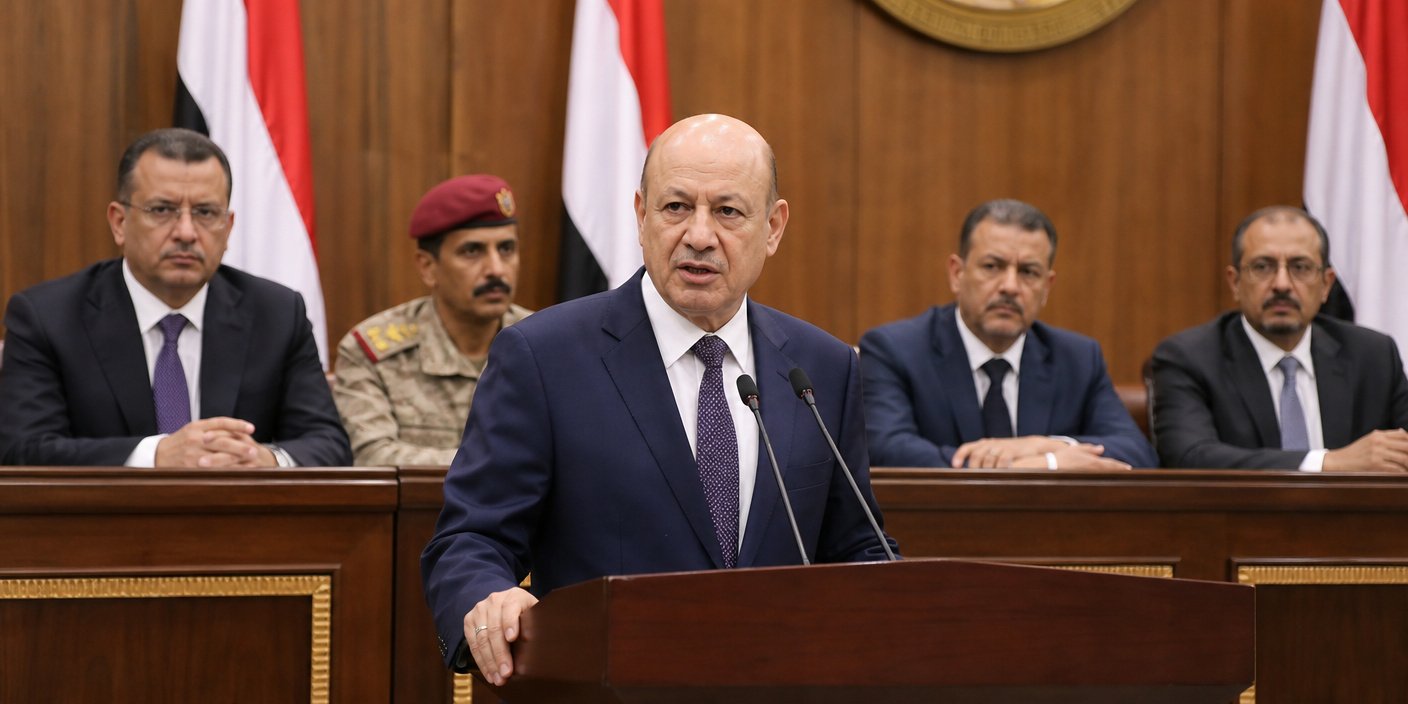
Rashad Al-Alimi, the chairman of Yemen’s Presidential Leadership Council (PLC), has mobilized state institutions, signaling a decisive shift toward full-scale military operations aimed at recapturing territory held by Houthi insurgents. This announcement, delivered as a direct mandate to the armed forces and state security apparatus, marks a significant departure from the fragile stalemate that has characterized the conflict in recent years, effectively placing the nation’s civil and military institutions on a state of high alert to support the reclamation of sovereign territory.
Key Highlights:
- Presidential Leadership Council (PLC) has officially transitioned to a high-alert status for all state military and civil institutions.
- The directive targets the full recapture of all territories currently under Houthi control.
- The strategic shift follows a prolonged period of diplomatic stalling and increased Houthi activity across multiple fronts.
- Government forces are being repositioned to initiate coordinated operations, aiming to restore central authority across key governorates.
Strategic Mobilization: A New Phase of Conflict
The declaration by Chairman Rashad Al-Alimi represents the most significant escalation of rhetoric and intent from the internationally recognized Yemeni government in recent history. By commanding state institutions to enter a state of high alert, the PLC is essentially signaling the end of a passive defensive posture. The objective is clear: to pivot from merely holding the current frontlines in Aden and surrounding liberated areas to an active, offensive strategy designed to dislodge Houthi forces (Ansar Allah) from their established strongholds.
The Operational Mandate
Military analysts suggest that this mobilization requires a multifaceted approach, combining ground-based advances with intensified coordination between the various factions comprising the PLC. Unlike previous defensive maneuvers, this directive implies a centralized command structure tasked with synchronizing resources. The focus is not merely on tactical gains but on the systematic restoration of state sovereignty. This involves logistics, intelligence sharing, and the reactivation of administrative functions in districts long severed from the central government in Aden. The logistical challenge is immense; it involves supplying troops across rugged terrain while simultaneously countering the Houthi drone and missile capabilities that have historically disrupted government supply lines.
Analyzing the Security Landscape
The decision to launch full-scale operations comes at a time of heightened regional volatility. The Houthis, having consolidated significant influence in the north, including the capital city of Sana’a, have leveraged the conflict to build a robust localized military infrastructure. For the PLC, reclaiming this territory is not just a territorial objective but a critical step in reasserting legitimacy on an international stage. The government’s strategy hinges on the belief that a revitalized military push will force a change in the Houthi calculus, compelling them to reconsider their intransigence at the negotiating table.
Secondary Angles: Contextualizing the Escalation
To understand the gravity of Al-Alimi’s announcement, one must look at three critical dimensions currently shaping the Yemeni landscape.
1. The Human and Infrastructure Cost
Renewed, full-scale warfare carries the inevitable risk of a deepening humanitarian crisis. While the government maintains that restoring state institutions is the only path to long-term stability, the immediate reality for civilians in contested zones is one of increased risk. Schools, hospitals, and critical water infrastructure have been caught in the crossfire for a decade; a fresh offensive threatens to complicate aid delivery routes further. The international community, already stretched thin by global crises, will likely watch closely to see if the PLC can implement a military strategy that minimizes civilian collateral damage.
2. Regional Geopolitical Alignment
The Houthis have frequently utilized the Yemeni conflict as a bargaining chip within the broader regional power struggle, particularly regarding the Red Sea shipping lanes. By moving to recapture territory, the PLC is also asserting its role as a necessary security partner for international actors concerned with maritime safety. This maneuver aligns the Yemeni government’s interests more closely with those of regional security coalitions, positioning the reclamation efforts as part of a broader push to restore order to the Red Sea corridor.
3. Economic Sovereignty and Resource Control
A critical, yet often overlooked, component of this military shift is economic. Much of Yemen’s resource wealth—including oil and gas reserves—sits in areas where the control lines are blurred. The PLC’s mandate is implicitly linked to securing these revenue streams. Without control over these resources, the government struggles to pay civil servant salaries, stabilize the local currency, and fund the very military it is now mobilizing. Reclaiming these territories is therefore an existential economic necessity for the government’s long-term sustainability.
FAQ: People Also Ask
1. What is the Presidential Leadership Council (PLC)?
The PLC is the internationally recognized governing body of Yemen, established in 2022 to unify various anti-Houthi factions under a single political authority. It is currently chaired by Rashad Al-Alimi.
2. Why is the recapture of Houthi-held territory considered a strategic shift?
It represents a move away from defensive containment and diplomatic stalemate toward an proactive, offensive military policy aimed at restoring state administration throughout the entire country.
3. What are the main challenges to this military operation?
The challenges include the rugged and mountainous geography of the Houthi-held north, the Houthis’ established network of drone and missile technology, and the delicate balance of maintaining regional stability while conducting active combat operations.
4. Will this affect regional shipping?
The Yemeni government argues that reclaiming sovereign territory is essential to restoring stability in the region, which could theoretically mitigate the threats to maritime navigation posed by Houthi operations in the Red Sea.