
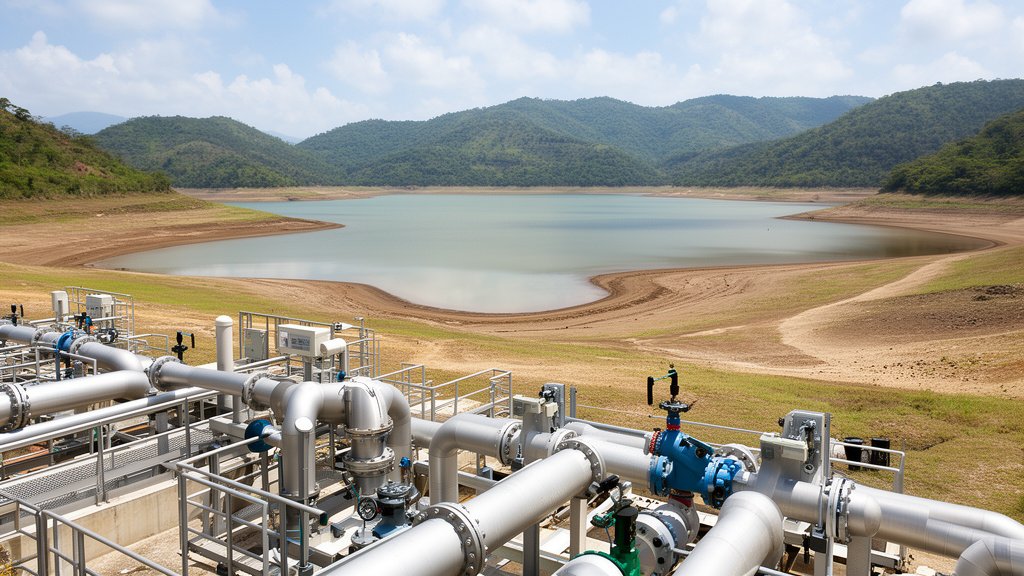
The National Water Commission (NWC) has officially initiated a stringent revision of water supply schedules for customers reliant on the Mona Reservoir, following a perilous decline in storage levels to 35.9%. Effective today, September 17, the NWC has mandated that daily water supply cut-offs will be advanced to 4:00 p.m. to preserve the remaining potable water inventory. This measure comes as a direct response to intensifying national drought conditions, which have placed immense strain on the island’s primary water storage facilities. The decision reflects a reactive yet necessary strategy to ensure the equitable distribution of water throughout the Kingston Metropolitan Area and surrounding districts during this period of hydrological scarcity.
Key Highlights
- Critical Capacity: The Mona Reservoir is currently operating at only 35.9% of its total capacity, signaling a high-risk operational environment.
- New Restriction Protocol: Effective September 17, daily water supply cut-offs have been moved forward to 4:00 p.m. to extend the utility’s supply duration.
- National Context: The restriction is part of a broader, government-led response to sustained, severe drought conditions across the region.
- Consumer Impact: Affected customers are urged to store water responsibly and adjust usage patterns to accommodate the earlier service termination.
The Urgent Operational Shift: Managing the Mona Reservoir Deficit
The National Water Commission’s decision to move the cut-off time to 4:00 p.m. is not merely a logistical adjustment; it is a critical safeguard against the total depletion of the Mona Reservoir’s accessible reserves. Hydrologists and engineers at the NWC analyze the reservoir’s drawdown rates daily, balancing the immediate demands of a growing population against the dwindling inflow from catchment areas.
The Mechanics of the 4:00 PM Cut-off
When reservoir levels hover in the mid-30 percentile, the margin for error effectively vanishes. By scheduling the supply cessation for 4:00 p.m., the NWC aims to manage pressure levels within the network. This prevents ‘air-locking’—a phenomenon where empty pipes allow air to enter the distribution system, causing significant damage and requiring lengthy re-pressurization cycles. By shutting off supply earlier, the commission can maintain ‘static pressure’ in the lines, which is essential for preserving infrastructure integrity during water-scarce periods.
Analyzing the Drought Dynamics
The current situation is exacerbated by a pattern of irregular rainfall and higher-than-average temperatures. The Caribbean region has seen shifts in climate patterns that have altered traditional rainy seasons, leaving reservoirs like Mona—a critical asset for the Kingston area—vulnerable to rapid depletion. The 35.9% figure is particularly alarming because it encroaches upon the ‘dead storage’ limit, where water quality can sometimes be compromised by sediment concentration. Thus, the NWC is not only managing quantity but also monitoring water quality, which often necessitates more complex treatment processes as the water level drops.
Long-Term Infrastructure and Resilience
While the current restrictions are a short-term crisis management tool, the situation underscores the urgent need for long-term infrastructure adaptation. Experts often point to the need for increased storage capacity, wastewater recycling programs, and the implementation of smart-metering technologies to detect leaks earlier. The NWC has engaged in various projects to diversify water sources, including the exploration of new wells and the optimization of existing treatment plants. However, these projects are long-term capital investments that require sustained funding and political will. In the interim, public conservation remains the primary defense against total system failure.
Socio-Economic Ripple Effects
The economic impact of water restrictions is multifaceted. Small and medium-sized enterprises, particularly in the hospitality, food, and manufacturing sectors, face increased operational costs as they invest in storage tanks and commercial water trucking services to maintain operations. Households, meanwhile, face significant disruption to daily routines. The NWC has appealed for patience and cooperation, noting that the timing of supply restoration is heavily dependent on technical evaluations conducted at the facility. For vulnerable communities without private storage infrastructure, these restrictions present a stark challenge, reinforcing the need for centralized water supply management to be as efficient and transparent as possible.
FAQ: People Also Ask
Q: Why was the cut-off time set for 4:00 p.m. specifically?
A: The 4:00 p.m. deadline is based on technical modeling that calculates the necessary pressure levels required to prevent pipe damage and ensure equitable distribution. It allows the NWC to maintain system integrity while extending the duration of the water supply over the coming weeks.
Q: Is the Mona Reservoir the only affected area?
A: While the Mona Reservoir is the primary focus of this announcement due to its 35.9% level, the NWC continues to monitor all water systems across the nation. Drought conditions are widespread, and other systems may face similar restrictions if rainfall patterns do not improve.
Q: How long will these restrictions last?
A: The NWC has not provided a specific end date. The restrictions will remain in place until the reservoir levels show a sustainable recovery, which is dependent on significant, sustained rainfall in the reservoir’s catchment areas.
Q: What can residents do to prepare?
A: The NWC advises customers to store water in clean, covered containers before the 4:00 p.m. cut-off. Residents are also urged to implement aggressive water conservation measures, such as fixing leaky faucets and reducing non-essential water usage, to assist in managing the limited supply.