
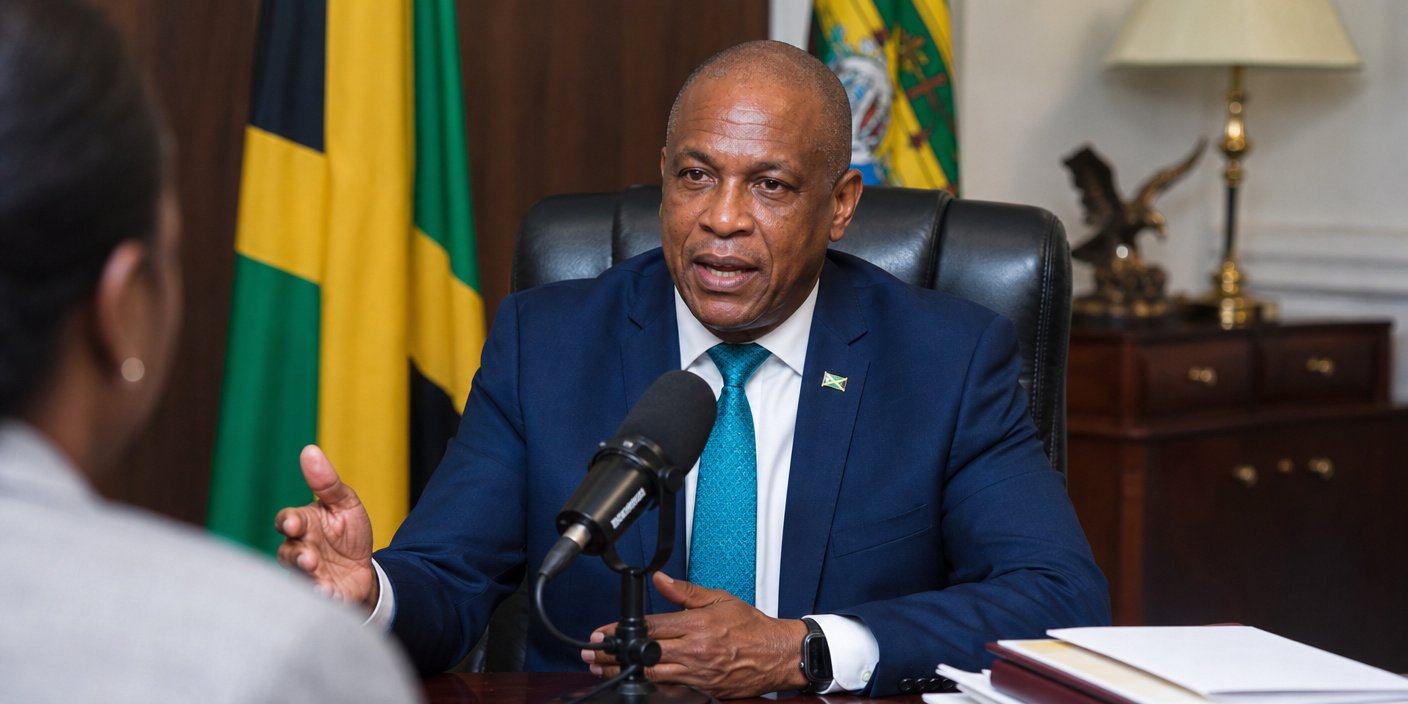
The political discourse in Jamaica has sharpened significantly following allegations by the Opposition People’s National Party (PNP) regarding the management and reporting of road repair funds. The PNP has directly challenged claims made by Minister of Local Government and Rural Development, Desmond McKenzie, asserting that the government’s touted figures of $600 to $700 million in monthly road maintenance allocations are fundamentally misleading. This confrontation has reignited a long-standing debate concerning fiscal transparency, the definition of infrastructure maintenance, and the operational capacity of municipal corporations to address the country’s crumbling secondary and tertiary road networks.
Key Highlights
- The Funding Dispute: The PNP argues that the Minister’s reported $600-$700 million monthly figures are not purely for new road repairs but conflate broad maintenance costs, creating a false impression of resource availability.
- Chronic Underfunding: Local authorities, including Parish Municipal Corporations, maintain that the funds reaching the ground are insufficient to meet the pressing needs of pothole repairs and road rehabilitation.
- Demand for Clarity: The Opposition is calling for a transparent breakdown of the actual capital expenditure versus operational maintenance to prevent public deception.
- Infrastructure Crisis: The debate highlights the broader issue of failing rural infrastructure, which continues to impact local commerce, public safety, and transportation efficiency across Jamaica.
The Financial Shell Game: Analyzing the Discrepancy
At the heart of the current controversy is a fundamental disagreement over how government spending on infrastructure is classified and communicated to the public. When Minister Desmond McKenzie presents figures suggesting that $600 to $700 million is being funneled into road works on a monthly basis, the Opposition contends that this number is a statistical sleight of hand. The PNP’s argument is rooted in the distinction between targeted rehabilitation—projects specifically aimed at fixing road damage—and general maintenance, such as verge cleaning, drain clearing, and administrative overhead.
For residents in rural parishes, the visual reality of their infrastructure often contradicts the government’s expenditure reports. The PNP asserts that when these broad operational costs are stripped away, the actual capital allocated for fixing potholes and rehabilitating deteriorated roadways is a fraction of the claimed amounts. This mismatch has created a “perception gap” where the government claims robust investment while citizens traverse roads that have remained in a state of disrepair for years. The opposition is demanding that the Ministry provide a granular audit of where these funds are actually going, questioning whether the administrative layers of the Ministry of Local Government and Rural Development are consuming resources that should be allocated directly to municipal contractors.
Impact on Local Municipalities
The ripple effects of this funding dispute are felt most acutely at the level of the Parish Municipal Corporations. These bodies are tasked with the daily management of tertiary roads—the very arteries of local economic activity. Without consistent, ring-fenced funding, municipal corporations are often forced to engage in “patch-work” solutions that fail under the first heavy rainy season. By conflating general maintenance with capital improvement, the central government may be inadvertently starving these local bodies of the long-term investment required for sustainable road infrastructure. The PNP’s criticism suggests that the current funding model is not just insufficient, but is designed to provide a veneer of activity that masks deep-seated structural neglect.
Economic and Social Consequences
The secondary angle to this controversy is the severe economic toll of poor road infrastructure. Neglected roads directly correlate to higher vehicle maintenance costs for citizens, delayed public transportation services, and logistical bottlenecks for farmers attempting to bring produce to market. When public trust in the reporting of funds erodes, it creates a dangerous apathy regarding government projects. If the public believes that allocated funds are being mismanaged or mischaracterized, the willingness to support future infrastructure levies or government initiatives diminishes. This transparency issue is, therefore, not merely a political spat; it is an economic issue that hinders national productivity.
A Call for Fiscal Accountability
Moving forward, the PNP is doubling down on its demand for a transparent fiscal breakdown. They are pushing for a policy shift where road repair funds are ring-fenced and reported separately from the broader maintenance budgets of the Ministry. The government, conversely, often points to the complexities of “whole-of-government” maintenance strategies, where clearing drains is inextricably linked to preserving road longevity. The resolution of this debate will require more than political posturing; it will likely necessitate a third-party audit or an accessible public dashboard that tracks infrastructure spending from the Ministry down to the specific road segment being repaired. Until such transparency is achieved, the numbers battle will continue to obscure the real progress—or lack thereof—on Jamaica’s roads.
FAQ: People Also Ask
1. What is the main point of contention regarding the $600-$700 million figure?
The PNP argues that this figure is misleading because it includes general maintenance (like cleaning drains and trimming verges) rather than being dedicated solely to road rehabilitation and pothole patching, as the public might be led to believe.
2. How does this funding dispute affect Parish Municipal Corporations?
It impacts them by centralizing the narrative around spending while potentially masking the reality that these local bodies are underfunded and unable to perform essential, large-scale road repairs due to a lack of direct, ring-fenced capital.
3. Why is the PNP emphasizing ‘transparency’ in their criticism?
The opposition is attempting to hold the government accountable for the disconnect between stated expenditure and the actual condition of roads, arguing that the public is being deceived by “inflated” figures that do not translate into tangible infrastructure improvements.
4. What does the Ministry of Local Government say in response?
The Ministry typically defends these figures by citing the comprehensive nature of “maintenance,” arguing that road upkeep involves much more than just repairing the asphalt surface, and that a holistic approach is necessary for infrastructure preservation.