
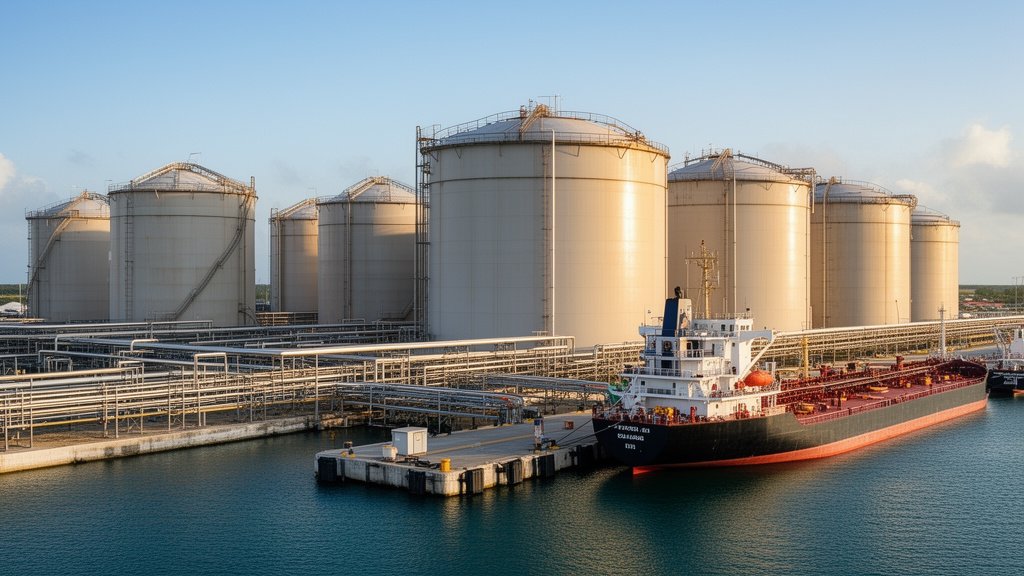
West Indies Petroleum Terminal Limited (WIPT) has announced a significant financial milestone, recording a 51 per cent increase in net profit over the recent six-month period. This robust performance is largely attributed to the company’s strategic decision to aggressively pursue and successfully integrate business from third-party customers, effectively diversifying its revenue streams beyond traditional operations.
Key Highlights
- 51% Net Profit Increase: WIPT achieved a major growth milestone in its latest six-month financial reporting period.
- Third-Party Diversification: The surge in profitability is primarily driven by the successful onboarding and operational support of external third-party clients.
- Operational Scaling: Increased volume from outside customers has optimized terminal utilization rates.
- Strategic Market Positioning: The results underscore WIPT’s critical role in the Caribbean energy logistics value chain.
Unlocking Growth: The Shift to Third-Party Logistics
The 51 per cent profit surge reported by West Indies Petroleum Terminal Limited is not merely a reflection of favorable market conditions, but a clear indicator of a successful pivot in corporate strategy. For years, petroleum storage terminals—often utilized as captive assets for proprietary trading or local distribution—have operated on fixed-volume models. By opening its terminal facilities to third-party customers, WIPT has effectively transitioned from a standard storage provider to a vital regional logistics hub.
The Economics of Third-Party Storage
At the core of this growth lies the economics of throughput and storage utilization. Petroleum terminals derive revenue from two primary sources: the lease of storage tank capacity and the handling fees associated with the throughput of product (loading and offloading). When a terminal restricts itself to a single owner or a limited set of internal clients, it risks leaving capacity idle during market downturns or production lulls.
By inviting third-party players—such as independent fuel traders, regional distributors, and international oil companies—WIPT has maximized its tank turnaround times. The “outside customer” model allows for a consistent stream of revenue that is less dependent on the cyclical nature of a single supplier’s operations. This model creates a “multiplier effect” where the variable costs of handling higher volumes are offset by the high fixed-margin benefits of optimized asset utilization.
Impact on the Caribbean Energy Value Chain
The Caribbean energy market is uniquely sensitive to logistics and storage capabilities. Unlike large landlocked nations with vast pipeline networks, island economies rely heavily on marine logistics and well-placed storage terminals to ensure energy security. WIPT’s ability to attract third-party business suggests that they have successfully positioned their facility as a reliable “neutral” partner in this ecosystem.
This neutrality is crucial. For regional distributors who may not own their own infrastructure, access to a high-capacity, efficiently managed terminal is the difference between consistent supply and market disruption. By serving as an intermediary, WIPT has essentially de-risked its revenue model while providing a liquidity service to the broader regional market.
Financial Resilience and Volatility
The reported growth is particularly noteworthy given the inherent volatility of the global petroleum sector. Over the last six months, fuel prices and demand signals have fluctuated due to geopolitical tensions and global economic shifts. WIPT’s financial results demonstrate that the “infrastructure layer” of the oil and gas industry—specifically, storage and handling—is often more insulated from price volatility than upstream exploration or downstream retail.
When prices are high, traders often look to store product in anticipation of future market corrections. When prices are low, distributors often move to stockpile for seasonal demand. In both scenarios, a third-party access terminal like WIPT remains in high demand, provided it offers the logistical agility required by international traders. This report confirms that WIPT has successfully captured this “middle-ground” market demand.
Future Outlook and Infrastructure Investment
Looking ahead, the 51 per cent profit growth provides the capital foundation necessary for further infrastructure upgrades. To sustain this trajectory, WIPT will likely need to focus on two distinct areas: digital integration and safety compliance. As third-party volumes increase, the complexity of managing inventory, manifests, and product quality for multiple clients becomes a significant operational hurdle.
Digital transformation in terminal management—specifically, automated inventory tracking and real-time scheduling—will be the next logical step to maintain margins. Furthermore, with the increased throughput comes increased scrutiny on environmental safety and terminal integrity. Continued reinvestment into modern firefighting systems, spill prevention technology, and terminal maintenance will be critical to retaining these high-value third-party accounts, who prioritize supply chain reliability above all else.
In conclusion, WIPT’s recent performance serves as a case study in operational diversification. By evolving their business model to embrace external partners, they have not only bolstered their balance sheet but have cemented their status as a central pillar of regional energy infrastructure.
FAQ: People Also Ask
What is the core reason for WIPT’s profit increase?
The 51 per cent increase in net profit is primarily driven by the expansion of its third-party customer base, allowing for better asset utilization and diversified revenue streams.
Why are third-party customers significant for petroleum terminals?
Third-party customers provide non-proprietary volume, which ensures that storage tanks and loading infrastructure are utilized at higher rates, generating steady revenue through throughput and storage fees regardless of the terminal owner’s own supply fluctuations.
What impact does this growth have on the regional energy market?
It enhances the reliability of the regional energy supply chain by providing independent traders and distributors with essential, accessible infrastructure, which is critical for island-based economies that rely on marine-delivered fuel.
Is this type of profit growth sustainable?
While past performance does not guarantee future results, the shift toward a third-party logistics model creates a more stable, diversified revenue base that is generally more resilient to market volatility than proprietary, single-source models.