
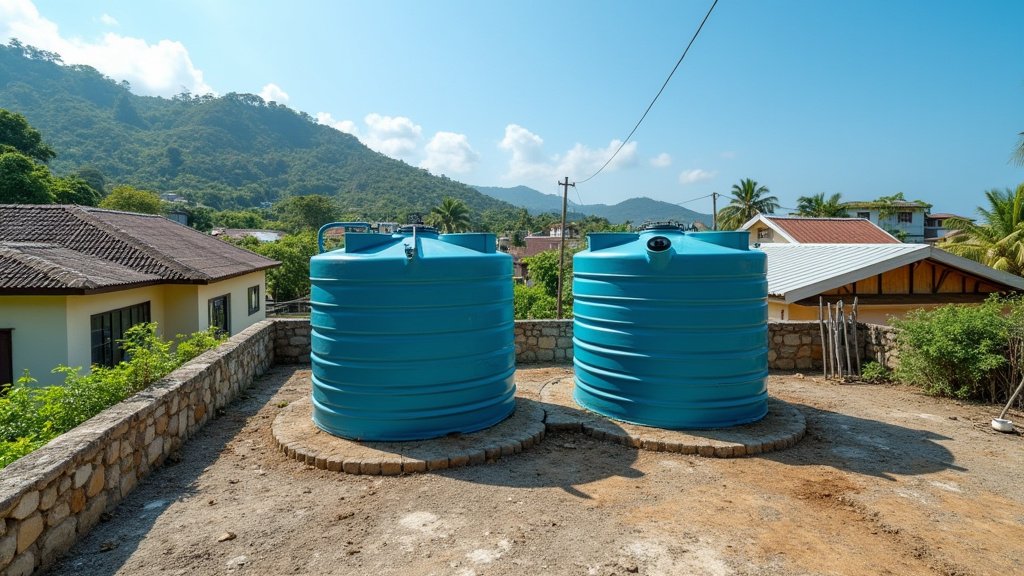
In a decisive move to bolster regional disaster resilience, the Rotary Club of Trafalgar New Heights and the Rotary Club of Montego Bay have successfully finalized the installation of critical water infrastructure in the community of Maroon Town, St. James. The project, which provides two 2,000-gallon water tanks, directly addresses the ongoing water insecurity faced by residents following the severe structural damage caused by Hurricane Melissa in 2025.
Key Highlights
- Joint Humanitarian Effort: A partnership between the Rotary Club of Trafalgar New Heights and the Rotary Club of Montego Bay successfully executed this infrastructure project.
- Critical Infrastructure: Installation of two 2,000-gallon water tanks, significantly increasing the storage capacity for the Vaughnsfield housing scheme.
- Strategic Funding: The initiative was made possible through a targeted grant from Rotary District 7020.
- Post-Disaster Recovery: This project serves as a key recovery component following the widespread infrastructure failure caused by Hurricane Melissa in 2025.
Strengthening Infrastructure in the Wake of Climate Volatility
The provision of reliable water access remains a primary challenge for rural communities in Jamaica, particularly following the intensifying impact of tropical cyclones. The recent installation of two 2,000-gallon water tanks in the Vaughnsfield housing scheme within Maroon Town represents a critical intervention in community disaster preparedness.
Following the 2025 impacts of Hurricane Melissa, which severely damaged local water distribution networks and left many households without consistent supply, residents of Maroon Town faced immediate and long-term water deficits. This project, spearheaded by the Rotary Club of Trafalgar New Heights and the Rotary Club of Montego Bay, moves beyond emergency relief to provide a sustainable, long-term solution.
Integrating Rainwater Harvesting Technology
At the heart of the project is the implementation of a robust rainwater harvesting system. Unlike centralized municipal systems, which are vulnerable to localized damage during severe weather, distributed rainwater collection allows individual communities to maintain independence and resilience. The tanks, sourced and funded through a strategic grant from Rotary District 7020, are engineered to capture high volumes of precipitation, effectively buffering the Vaughnsfield housing scheme against drought periods and municipal infrastructure failures.
Engineering experts involved in the installation note that the tanks are strategically positioned to maximize runoff from roof surfaces within the scheme, ensuring that collection is efficient even during moderate rainfall events. This decentralization of water management is increasingly viewed as a best-practice model for Caribbean rural development, mitigating the reliance on vulnerable downstream piping.
The Socio-Economic Ripple Effect
Water security is a fundamental precursor to economic stability. For the residents of Maroon Town, the loss of consistent water access following Hurricane Melissa created ripples across local commerce and domestic health. The restoration of this supply is not merely a logistical win but a vital socio-economic stabilization measure.
By leveraging the operational bandwidth of the Rotary Club of Trafalgar New Heights and the resources of the Montego Bay chapter, the project exemplifies the ‘multiplier effect’ of local service organizations. The funding from Rotary District 7020 was pivotal, transforming the intention of recovery into a tangible, high-capacity asset. This collaboration serves as a case study for future NGO-led infrastructure projects in St. James, demonstrating how specific, localized investments can yield outsized community benefits.
Future-Proofing for Climate Resilience
While the immediate crisis of 2025 necessitated this intervention, the long-term objective of this project is climate adaptation. As weather patterns in the Caribbean become increasingly erratic, the ability to store water on-site will prove essential for the survival and prosperity of rural settlements like Maroon Town. Future phases of the initiative may include additional filtration upgrades to ensure that collected rainwater meets potable standards consistently throughout the year, further enhancing the health outcomes for the Vaughnsfield population.
FAQ: People Also Ask
Why are rainwater harvesting systems vital for Maroon Town?
Rainwater harvesting provides a decentralized water source that is independent of municipal pipes, which are often damaged during hurricanes. This ensures that even when the main grid fails, the community retains a supply for essential needs.
What specific impact did Hurricane Melissa have on the area?
In 2025, Hurricane Melissa caused significant structural damage to the water infrastructure in St. James. This resulted in prolonged outages and forced residents to rely on inefficient, temporary water trucking services.
How was this project funded?
The project was financed through a grant from Rotary District 7020, allowing the Rotary Club of Trafalgar New Heights and the Rotary Club of Montego Bay to procure and install the two 2,000-gallon tanks.
Is this model applicable to other rural communities?
Yes. The success of the Vaughnsfield installation provides a scalable framework. Rotary representatives suggest that the model of pairing local club implementation with District 7020 funding can be replicated in other high-risk areas across Jamaica.