
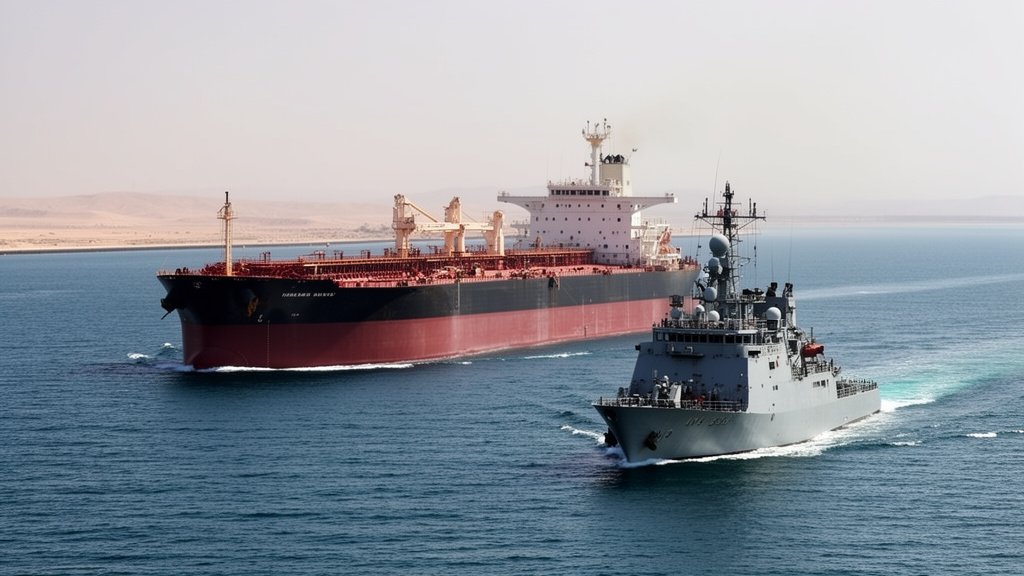
The geopolitical equilibrium in the Middle East has been violently disrupted following a provocative diplomatic move by the Trump administration. In an unprecedented escalation, a newly released map designating the vital Strait of Hormuz—the world’s most critical maritime oil chokepoint—as ‘new US territory’ has triggered immediate condemnation from Tehran and sent shockwaves through international markets. While the White House has since scrambled to soften the diplomatic rhetoric, labeling the move as non-binding, the damage to regional stability is palpable. The Strait, through which approximately 20% of the world’s total petroleum consumption flows daily, has now become the epicenter of a dangerous game of territorial brinkmanship.
The Cartographic Catalyst
The crisis began with the visual release of a map that ostensibly redraws maritime boundaries in the Persian Gulf. By labeling the Strait of Hormuz, a narrow waterway essential for the global economy, as ‘new US territory,’ the administration effectively challenged decades of established international maritime law, specifically the United Nations Convention on the Law of the Sea (UNCLOS). The map, which officials initially defended as a ‘clear strategic statement,’ has been interpreted by Iranian leadership as an act of territorial aggression. In response, Iranian officials have declared the waterway to be under the absolute authority of the Islamic Republic, warning that any encroachment will be met with immediate and decisive force.
The Economic Shockwaves of Maritime Chokepoints
The Strait of Hormuz is not merely a geographic location; it is a vital artery for the global economy. Approximately 21 million barrels of oil pass through these waters every day. The volatility introduced by the US map has sent immediate jitters through energy futures markets. Traders are pricing in a ‘risk premium’ on crude oil, fearing that the verbal escalation could rapidly devolve into kinetic naval skirmishes. Historical precedents, such as the ‘Tanker War’ during the 1980s, loom large in the minds of analysts. The market reality is stark: any meaningful disruption to the flow of traffic in the Strait would result in an immediate, global supply shock, driving inflation and threatening energy security for major importers, including China, India, and Japan.
Military Posturing in the Gulf
Beyond the diplomatic noise, the military reality on the ground—and on the water—is increasingly tense. The Islamic Revolutionary Guard Corps (IRGC) maintains a significant presence in the region, utilizing fast-attack craft and anti-ship missile batteries to enforce their maritime claims. Following the announcement, reports of heightened naval activity have emerged. The US Navy, operating within the framework of the Fifth Fleet, has been placed on an elevated posture of vigilance. The juxtaposition of a US territorial claim against a sovereign Iranian defensive perimeter creates a ‘flashpoint environment’ where miscalculation is the primary danger. Military strategists warn that in such narrow straits, the time window for de-escalation is measured in minutes, not hours.
The Diplomatic Walk-Back
Recognizing the potential for catastrophic misinterpretation, the US administration has attempted to adjust the narrative. Speaking on condition of anonymity, officials have clarified that the map does not constitute a formal legal declaration of annexation. Instead, they have pivoted to describing it as a ‘positional assertion’ meant to reinforce US security commitments to regional allies. This walk-back, however, has failed to dampen the outrage in Tehran. Iranian state media has framed the admission of non-legality as a sign of American weakness, further emboldening hardline factions to increase their patrols near the Strait. The diplomatic impasse continues, leaving the Strait of Hormuz in a state of fragile, high-stakes paralysis.
Strategic Implications and Future Trajectories
Looking ahead, this crisis highlights the precarious nature of international waters in an era of renewed great power competition. The incident raises critical questions about the erosion of international norms. If the territorial status of globally significant waterways can be unilaterally redefined for domestic political signaling, the entire architecture of global maritime law faces an existential threat. Furthermore, the incident serves as a stress test for alliances in the region. How the Gulf Cooperation Council (GCC) states navigate this conflict will determine their diplomatic standing for the next decade. Will they choose to align with the US assertion, or will they seek a neutral path to ensure the stability of their primary export route? The coming months will likely see a hardening of lines, with both sides utilizing hybrid warfare tactics—cyber-operations, maritime harassment, and proxy signaling—to assert dominance without triggering a full-scale kinetic war.
FAQ: People Also Ask
Why is the Strait of Hormuz so strategically important?
The Strait of Hormuz is the world’s most important oil chokepoint. Located between Oman and Iran, it connects the Persian Gulf with the Gulf of Oman and the Arabian Sea. Roughly one-fifth of the world’s petroleum consumption passes through this narrow waterway daily, making it critical to global energy prices and economic stability.
What does the UNCLOS say about maritime territory?
The United Nations Convention on the Law of the Sea (UNCLOS) sets clear rules for territorial waters, generally extending 12 nautical miles from a country’s coast. The Strait of Hormuz is an international waterway, and declaring it as a specific nation’s territory, particularly by a non-littoral state like the US, contradicts established international maritime legal frameworks.
Could this lead to a military conflict?
While diplomatic channels are attempting to clarify the nature of the map, the situation creates a high risk of miscalculation. The presence of both the US Navy and the IRGC in such close proximity, combined with heightened rhetoric, creates a ‘flashpoint’ where even a minor technical error or maritime collision could escalate rapidly into a kinetic engagement.
What has been the international market reaction?
Energy markets have reacted with volatility. The uncertainty regarding the status of the Strait has led to fluctuations in Brent and WTI crude oil futures, as investors hedge against the possibility of a supply disruption caused by potential blockades or military skirmishes in the region.