
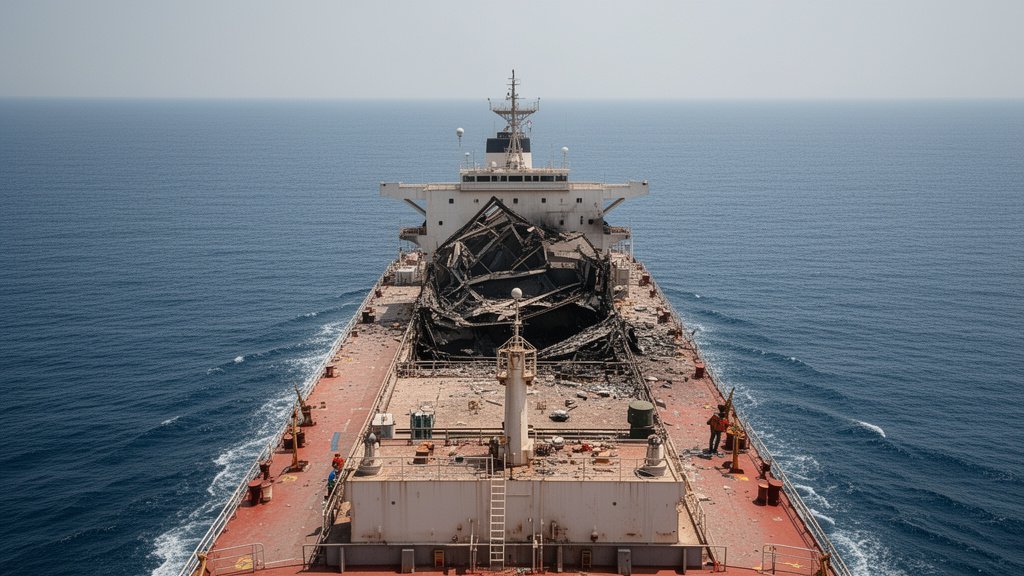
A commercial vessel has been struck by an unidentified projectile while transiting the volatile Strait of Hormuz, resulting in a confirmed crew casualty and significant structural damage. The Omani Coast Guard has launched an immediate emergency response operation, with international maritime security agencies scrambling to identify the source of the attack in one of the world’s most critical shipping arteries.
Key Highlights
- A commercial vessel sustained heavy damage following a direct hit by an unidentified projectile in the Strait of Hormuz.
- One confirmed crew casualty has been reported; medical evacuation and search protocols are currently active.
- The Omani Coast Guard is leading the emergency response and coordinating with regional partners to secure the area.
- International maritime security agencies, including the UKMTO, have issued urgent warnings to commercial traffic to exercise extreme caution in the region.
- The incident is expected to trigger a significant spike in maritime “War Risk” insurance premiums for vessels entering the Persian Gulf.
The Strait of Hormuz Attack: A Maritime Security Crisis
The Strait of Hormuz, a narrow waterway separating Iran and Oman, has once again become the epicenter of global maritime security concerns. Early reports indicate that a commercial vessel, while navigating the internationally recognized shipping lanes of the Strait, was struck by a projectile of unknown origin. The impact caused significant structural damage to the vessel’s upper deck and resulted in a confirmed crew casualty.
Emergency dispatchers from the Omani Coast Guard were the first to respond to the distress call, immediately coordinating with regional authorities to contain the situation. While the identity of the vessel and the precise nature of the projectile remain under investigation, the event marks a sharp escalation in what has historically been a “grey zone” of geopolitical maneuvering. For mariners and international logistics firms, the Strait is not merely a geographic location but a critical chokepoint through which approximately 20% of the world’s total petroleum consumption passes daily.
Immediate Response and Tactical Containment
The Omani Coast Guard’s rapid response protocol was activated within minutes of the distress signal. Current operations are focused on two fronts: stabilizing the damaged vessel to prevent environmental contamination and coordinating the medical evacuation of the injured crew member.
Maritime security analysts from the United Kingdom Maritime Trade Operations (UKMTO) have since issued a “high alert” status, advising all vessels in the vicinity of the Strait of Hormuz to maintain a heightened state of vigilance, increase stand-off distances from unidentified small craft, and prepare for potential evasive maneuvers. The coordination between the Omani Coast Guard and regional maritime security forces—including the International Maritime Security Construct (IMSC)—underscores the fragility of the peace in these waters. If the projectile was launched from a shore-based battery, coastal defense systems, or a mobile platform, the technical investigation will likely take days, if not weeks, to conclude.
The Geopolitical Powderkeg: Why the Strait Matters
The Strait of Hormuz is arguably the most sensitive maritime choke point on Earth. It connects the Persian Gulf with the Gulf of Oman and the Arabian Sea. Any disruption—whether physical, cyber, or tactical—has immediate, cascading effects on the global economy. This incident is particularly concerning because it deviates from previous “harassment” tactics, such as buzzing vessels with drones or verbal warnings.
The infliction of a casualty and significant structural damage suggests a shift from intimidation to direct engagement. This creates a strategic dilemma for shipping conglomerates: do they re-route vessels around the Cape of Good Hope, adding weeks to transit times and millions in fuel costs, or do they continue to transit the Strait and absorb the increased risk of attack and the ballooning costs of War Risk insurance? The economic calculus is shifting rapidly, and stakeholders are looking toward the Omani authorities to establish a secure, verified corridor before trading resumes at pre-incident volumes.
Maritime Intelligence and Threat Vectors
Intelligence experts are currently scrutinizing the trajectory and signature of the projectile. In previous years, the Strait has seen a rise in “drone swarm” tactics and the use of anti-ship cruise missiles. However, the use of a projectile in this instance without immediate attribution creates a vacuum of information. If investigations conclude that this was a targeted strike by a non-state actor or a proxy force, it could trigger a new round of regional sanctions and increased naval presence from global powers.
The “Grey Zone” nature of this attack—meaning it is aggressive enough to cause damage but ambiguous enough to maintain plausible deniability—is a hallmark of modern asymmetrical warfare. Ships in this region often rely on the Automatic Identification System (AIS) to track their location, but in high-threat scenarios, many vessels choose to “go dark” or manipulate their AIS signatures, complicating the response for the Omani Coast Guard. The recovery of debris from the vessel’s hull will be the smoking gun required for any international attribution of blame.
Economic Repercussions: Insurance and Energy Flow
The immediate aftermath of such an attack is rarely just military; it is fundamentally economic. Lloyd’s of London and other major maritime insurance syndicates are likely already re-evaluating the risk profile for the Strait of Hormuz. When a ship is hit, the cost of insuring the cargo and the hull does not just rise marginally—it can double or triple overnight.
This spike in operating costs will inevitably be passed down the supply chain, impacting global energy prices and the cost of consumer goods that rely on maritime transport. Furthermore, if the threat is perceived as persistent, shippers may demand naval escorts. The presence of international naval coalitions, such as the IMSC, in the region is intended to deter such actions, but this incident proves that deterrence has limits. The global energy markets, particularly in Asia and Europe, will be watching the Omani Coast Guard’s daily updates with extreme scrutiny, as the security of their energy supply is intrinsically tied to the stability of these few nautical miles of water.
FAQ: People Also Ask
1. Why is the Strait of Hormuz so volatile?
It is one of the world’s most critical maritime chokepoints, through which roughly 20% of global oil consumption passes. Its narrow geography makes vessels easy targets for shore-based projectiles or small-craft harassment, making it a constant focal point for geopolitical tension.
2. What is the role of the Omani Coast Guard in this incident?
As the primary maritime security authority in the immediate vicinity, the Omani Coast Guard is responsible for the emergency response, search and rescue, and securing the scene of the incident to facilitate safe passage for other commercial vessels.
3. How does this affect global oil prices?
Any disruption in the Strait of Hormuz typically leads to a risk premium being added to oil prices. If the incident results in a long-term closure or restricted access to the waterway, global oil supplies would be severely constrained, leading to price volatility in energy markets.
4. What is the UKMTO’s advice during this crisis?
The United Kingdom Maritime Trade Operations (UKMTO) advises vessels to maintain maximum distance from suspicious craft, keep a 24/7 bridge watch, and immediately report any signs of maritime insecurity to their regional center.