
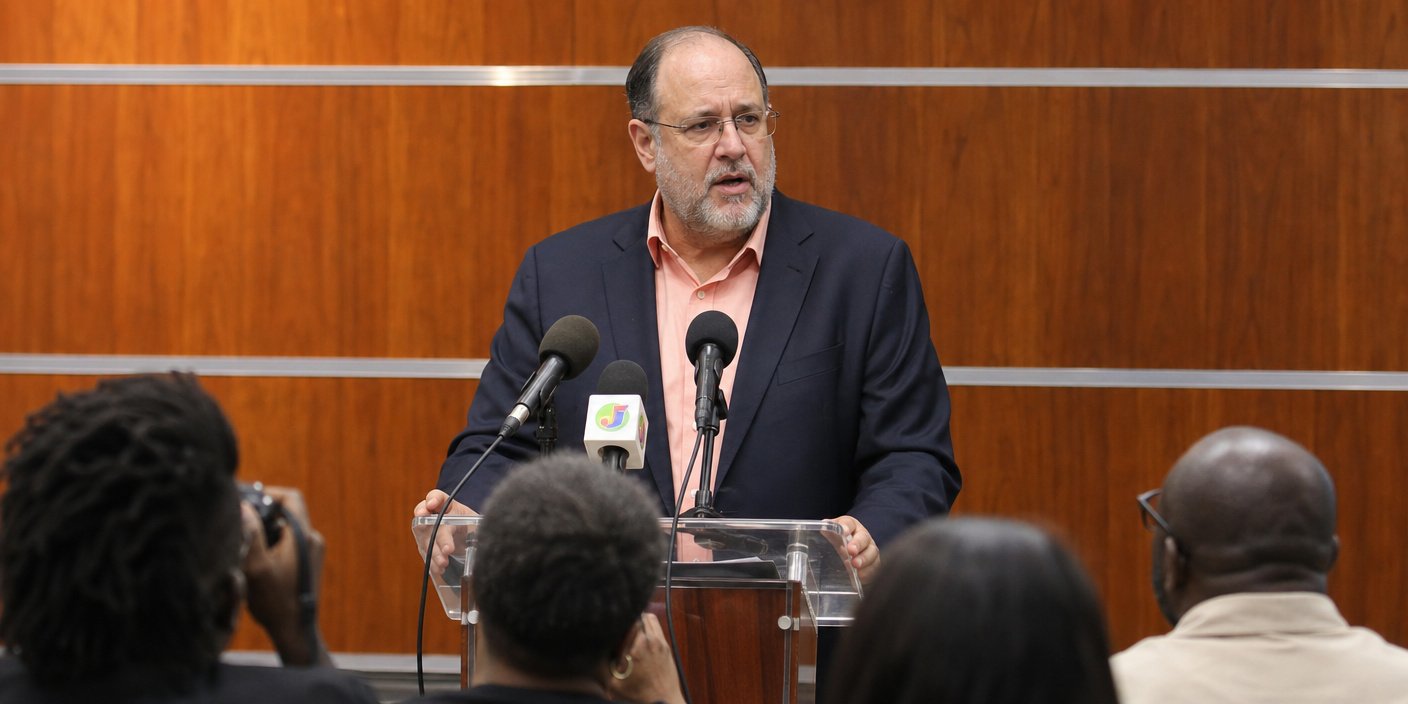
The People’s National Party (PNP) has formally addressed the fallout from a series of leaked audio recordings that have roiled the local political landscape. The leaked clips, which allegedly capture party officials strategizing to discredit Major General Antony Anderson, the head of the National Reconstruction and Resilience Authority (NRRA), have sparked significant debate regarding internal party conduct and political ethics.
In a decisive move to curb speculation, PNP President Mark Golding confirmed that the party has conducted an internal review of the allegations. Golding stated unequivocally that the conversations captured in the recordings did not take place within any official party forum, distancing the organization from the sentiments expressed by the voices on the tape.
Key Highlights
- Formal Rebuttal: PNP President Mark Golding has publicly stated that an internal review determined the leaked conversations were not sanctioned by the party.
- The Allegation: The recordings allegedly involved PNP officials plotting strategies to undermine Major General Antony Anderson, the current head of the National Reconstruction and Resilience Authority (NRRA).
- Strategic Distance: By clarifying that these discussions did not occur in an official forum, the PNP leadership aims to decouple the party’s institutional platform from the personal conduct of the individuals involved.
Navigating the Fallout: Accountability and Political Discourse
The emergence of the leaked audio has placed the PNP under the microscope, forcing leadership to balance the need for internal discipline with the necessity of maintaining a unified front. In modern political communications, the unauthorized release of private conversations—or “leaked audio”—has become a potent, if volatile, tool used to disrupt narratives and force opposition parties into defensive postures. The PNP’s rapid response, characterized by Mark Golding’s immediate call for an internal review, reflects a broader trend in strategic crisis management: verify, distance, and pivot.
The Role of the NRRA and Public Scrutiny
At the center of the controversy lies the National Reconstruction and Resilience Authority (NRRA). Major General Antony Anderson, who leads the authority, oversees critical national infrastructure projects and resilience planning. Given the NRRA’s high profile and its importance to national stability, any attempt to discredit its leadership carries significant political weight. The PNP’s desire to clarify its position stems not only from a need to avoid accusations of internal conspiracy but also to protect the party’s reputation as a government-in-waiting that respects the independence of public institutions.
The Mechanics of the Internal Review
Golding’s reliance on an “internal review” serves as a mechanism to signal administrative control. By framing the review as a procedural verification process, the party attempts to move the conversation from the sensationalism of the leaked audio to the legal and procedural reality of party operations. This approach seeks to contain the “scandal” within the realm of internal party dynamics, preventing it from spiraling into a broader national crisis. However, the effectiveness of such a move is always subject to public skepticism, particularly when the details of the “review” remain largely opaque to the general electorate.
Political Communications in the Digital Age
This incident underscores the fragility of political messaging in the digital era. With the prevalence of smartphone recording technology and the speed at which audio can be disseminated via social media, political parties are increasingly vulnerable to “hot mic” moments and unauthorized leaks. The PNP’s experience is a case study in the new baseline for political operations: every conversation, even those outside of formal meetings, carries the potential to become a public record. The incident forces a reckoning regarding the culture of political discourse and the lines between strategic campaigning and unethical maneuvering.
Future Implications for Party Unity
Beyond the immediate PR damage control, the leak raises questions about the cohesion within the PNP. While leadership has distanced the party from the specific comments made in the audio, the existence of such dialogue suggests underlying friction or competing agendas within the broader party ecosystem. For Mark Golding, the challenge moving forward will be to ensure that the party remains disciplined and that internal disagreements—should they exist—do not manifest in ways that can be exploited by political opponents. The ability to maintain party unity while navigating these digital-age pitfalls will be a key metric of his leadership heading into future electoral cycles.
FAQ: People Also Ask
What was the specific nature of the leaked audio concerning Major General Antony Anderson?
The leaked audio reportedly contains conversations between individuals identified as PNP officials discussing strategies to discredit Major General Antony Anderson, who leads the National Reconstruction and Resilience Authority (NRRA).
What was Mark Golding’s official response to the incident?
PNP President Mark Golding initiated an internal review. He subsequently stated that the party’s investigation concluded the conversations in the recordings did not take place within any official party forum, effectively distancing the PNP as an organization from the statements made.
What is the National Reconstruction and Resilience Authority (NRRA)?
The NRRA is a critical government body responsible for overseeing national infrastructure reconstruction and resilience initiatives. It is tasked with managing large-scale projects, making its leadership a subject of high public and political interest.
Will there be further investigations into the leak?
While the PNP has conducted its internal review to establish whether the party forum was involved, further investigations by external bodies or law enforcement would depend on whether any laws, such as those regarding privacy or defamation, were violated, which remains a matter of legal speculation.