
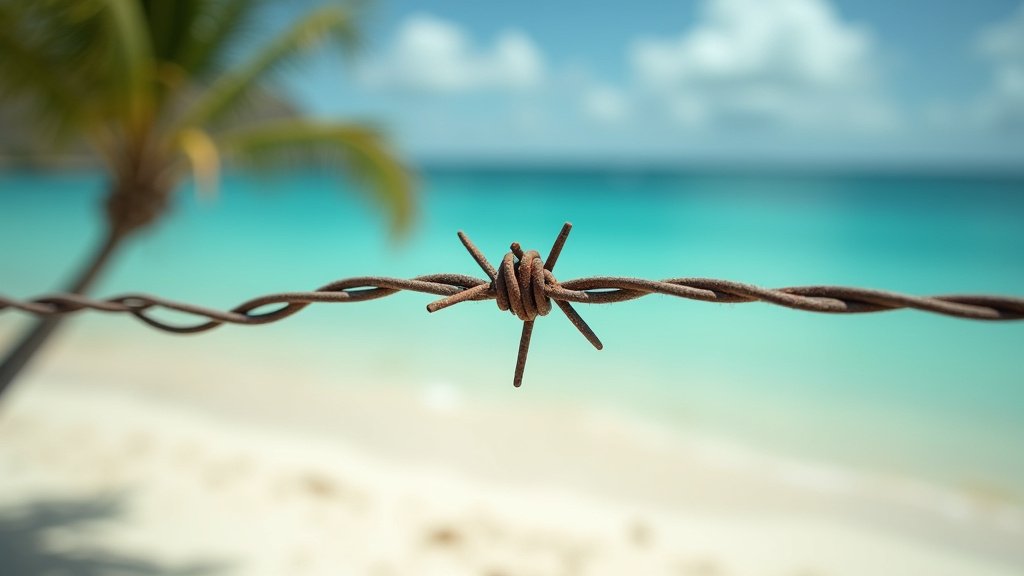
A viral video showing a section of Jamaica’s world-renowned Seven Mile Beach cordoned off by barbed wire has sparked immediate and widespread public outrage, forcing local authorities to confront the growing tension between private property security and public access. The footage, captured and circulated by local hotelier and runner Winthrop Wellington, displayed a stark, industrial barrier cutting across the pristine sands of Negril—a visual antithesis to the destination’s reputation for freedom and accessibility. While the property owner has defended the move as a desperate measure to deter persistent theft, the incident has catalyzed a broader conversation about the creeping privatization of Jamaica’s most famous natural assets.
Key Highlights
- The Catalyst: A viral video posted by Winthrop Wellington documented a section of Seven Mile Beach being obstructed by barbed wire, preventing his regular morning run and effectively splitting the public beach.
- The Defense: Diego Heaven, owner of the Reef Explorer dive centre, stated the fencing was intended to protect business equipment from recurring theft and vandalism, not to exclude the public.
- National Anxiety: The incident has tapped into long-standing fears among locals that public access to Jamaica’s coastlines is being slowly eroded by private, unchecked development.
- Regulatory Scrutiny: Public calls are mounting for stricter oversight by the National Environment and Planning Agency (NEPA) to ensure the coastline remains a public commons.
The Clash Between Private Security and Public Trust
The image of jagged, rusted barbed wire strung across the soft, white sand of Negril—a landscape synonymous with relaxation and tourism—created an immediate visceral reaction. For many Jamaicans, the beach is more than just a geographic feature; it is a vital, non-negotiable commons. Winthrop Wellington, who captured the footage, described the experience of being stopped in his tracks as a “shocking and unacceptable” moment. His account of the event underscored a deeper anxiety: that the beach, an asset that belongs to no one and everyone, was being carved up for private interest.
This incident is not an isolated one, but rather a flashpoint in a simmering conflict. Over the years, as Negril has developed into a premier global tourist destination, the pressure on land has intensified. Property owners, faced with the realities of operating businesses in high-traffic areas, often cite security as a primary concern. Diego Heaven, representing the Reef Explorer dive centre, offered a perspective that highlights the struggles of local entrepreneurs. According to Heaven, the decision to install the fence was a reactive measure against a wave of property crime. “Our intention is never ever to lock anyone out from the beach… all we’re trying to do is protect our property,” he explained, noting that theft and vandalism had forced his hand.
The Erosion of the ‘Public Commons’
However, the optics of the situation have overshadowed the owner’s intent. When public space is enclosed, the immediate assumption is one of entitlement—that a private entity is prioritizing its profit margins over the collective enjoyment of the community. In the Caribbean context, this is a highly sensitive topic. The historical legacy of colonial land ownership and the struggle for indigenous and local access to the sea remains a potent cultural touchstone. When a barrier appears on the sand, it is rarely viewed merely as a security measure; it is seen as a hostile takeover of public territory.
Economic Implications for Tourism
Negril’s brand is built on accessibility. The concept of the ‘Seven Mile Beach’ relies entirely on the notion that a visitor—or a local—can walk the entirety of the shoreline without interruption. If the beach becomes segmented by fences, wires, and barriers, the core value proposition of the destination diminishes. For the tourism sector, the incident serves as a warning. Tourists who visit Jamaica to experience the ‘unspoiled’ Caribbean often react negatively to signs of industrialization or exclusionary practices. Economic growth in the region depends on maintaining the balance between high-end private luxury and the accessible, authentic cultural experience that the public beach provides.
The Regulatory Challenge
Moving forward, the burden falls on regulators, specifically the National Environment and Planning Agency (NEPA) and the local parish authorities. The incident has highlighted a potential gap in enforcement and clarity regarding where private property ends and the public beach begins. As the Jamaican government looks to boost tourism numbers, it must also provide businesses with better security solutions that do not involve militarizing the coastline. The conflict between local business survival and public amenity rights requires a policy framework that prioritizes the ‘commons’ while respecting the legitimate security needs of property owners.
FAQ: People Also Ask
Q: Was the barbed wire permanently installed on the beach?
A: No, the installation was temporary. The rapid public outcry and media attention led to the quick removal of the fencing, though the incident has prompted a broader investigation into coastal property regulations.
Q: Is it legal to put fences on beaches in Jamaica?
A: Generally, the foreshore and the immediate coastline are considered public property in Jamaica. While businesses may own the land adjacent to the water, they are usually prohibited from obstructing the public’s right of way along the high-water mark.
Q: What is the primary concern raised by the public?
A: The primary concern is the ‘privatization’ of the beach. Residents and frequenters of Seven Mile Beach fear that allowing even minor encroachments sets a precedent that will eventually lead to the destruction of the open, public nature of the beach.