
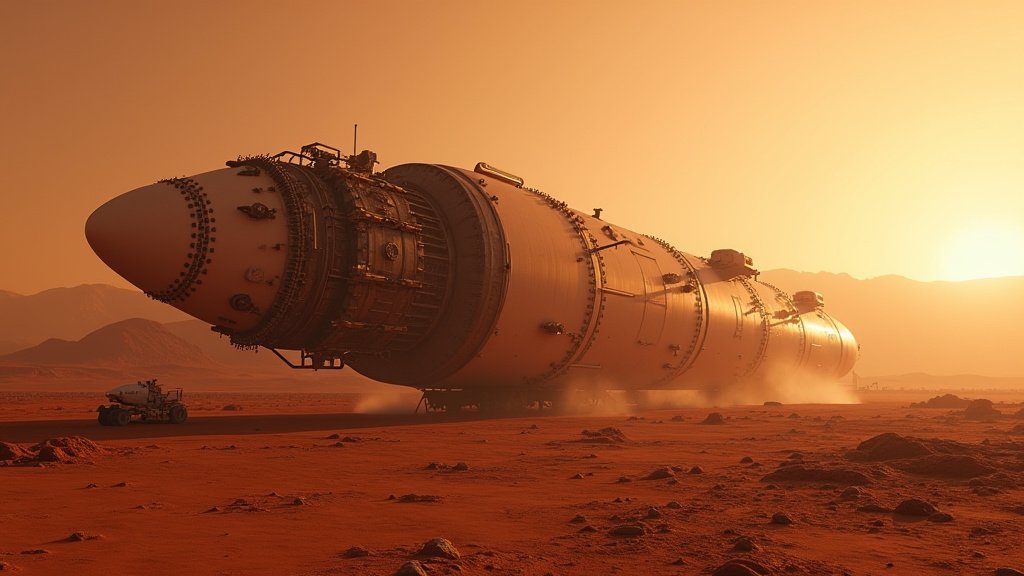
Elon Musk’s SpaceX is setting its sights firmly on the Red Planet with a detailed roadmap for Starship’s ambitious Mars colonization efforts. The company recently shared updated projections and technological advancements, underscoring a commitment to making humanity a multi-planetary species. This renewed focus comes as SpaceX continues to advance Starship’s capabilities through iterative testing, aiming for orbital flights and eventual interplanetary missions.
Key Highlights:
- SpaceX aims to land the first Starship on Mars by the mid-2030s.
- The plan involves extensive use of in-situ resource utilization (ISRU) for fuel production and life support.
- Starship’s massive payload capacity is crucial for transporting necessary equipment and habitats.
- Regular cargo and crewed missions are envisioned to build a self-sustaining Martian base.
Starship’s Path to the Red Planet
SpaceX’s long-term vision for Mars hinges on the full development and operationalization of its Starship system. The stainless-steel behemoth, designed for full reusability, is central to reducing the cost of space access and enabling large-scale interplanetary transportation. Elon Musk has consistently emphasized that the ultimate goal is to establish a self-sustaining city on Mars, a feat requiring unprecedented logistical and technological innovation.
Technological Pillars for Mars
The success of a Mars mission relies on several critical technological advancements. One of the most vital is the ability to produce propellant on Mars itself. SpaceX plans to utilize Martian atmospheric carbon dioxide and subsurface water ice to create methane and oxygen, the same propellants that will fuel Starship’s return journey to Earth and subsequent launches from Mars. This process, known as in-situ resource utilization (ISRU), is a cornerstone of making long-duration, high-cadence missions economically feasible. The sheer volume of resources required for a sustained presence necessitates Starship’s unparalleled payload capacity, estimated to be over 100 tons for a Mars transit.
Phased Approach to Colonization
SpaceX’s strategy is not a single leap but a series of carefully planned phases. Initially, uncrewed Starship missions will focus on delivering essential infrastructure, including power generation, life support systems, and the ISRU propellant plants. Once these are operational and proven reliable, the first crewed missions will follow. These early crews will be tasked with establishing a basic habitat and expanding the ISRU capabilities. Subsequent missions will bring more personnel, additional habitats, scientific equipment, and the resources needed to grow the Martian settlement into a self-sufficient colony, potentially supporting thousands of people.
Overcoming Martian Challenges
The Martian environment presents formidable challenges, including extreme temperatures, a thin atmosphere, and cosmic radiation. Starship is designed with robust life support systems and radiation shielding, but long-term solutions will involve establishing habitats that offer substantial protection. Furthermore, the psychological and physiological effects of long-duration space travel and living in an isolated, alien environment are significant considerations that SpaceX and NASA are actively studying. The development of a reliable transportation system like Starship is the foundational step in addressing these complex issues.
FAQ: People Also Ask
When is SpaceX planning to send humans to Mars with Starship?
While an exact date has not been finalized, Elon Musk has indicated a target for the first human landing on Mars in the mid-2030s, contingent on the successful development and testing of the Starship system.
How will Starship refuel on Mars?
SpaceX plans to use in-situ resource utilization (ISRU) to produce methane and oxygen propellant from the Martian atmosphere and subsurface ice, enabling Starship to refuel for its return journey.
What is the primary goal of SpaceX’s Mars missions?
The primary goal is to establish a self-sustaining human civilization on Mars, making humanity a multi-planetary species.
What are the biggest challenges for a Mars mission?
Key challenges include the long transit time, radiation exposure, the harsh Martian environment (temperature, atmosphere), and the logistical complexities of supporting a human settlement.
How much can Starship carry to Mars?
Starship is designed to carry over 100 tons of payload to Mars, a capability crucial for transporting the necessary infrastructure, supplies, and personnel.