
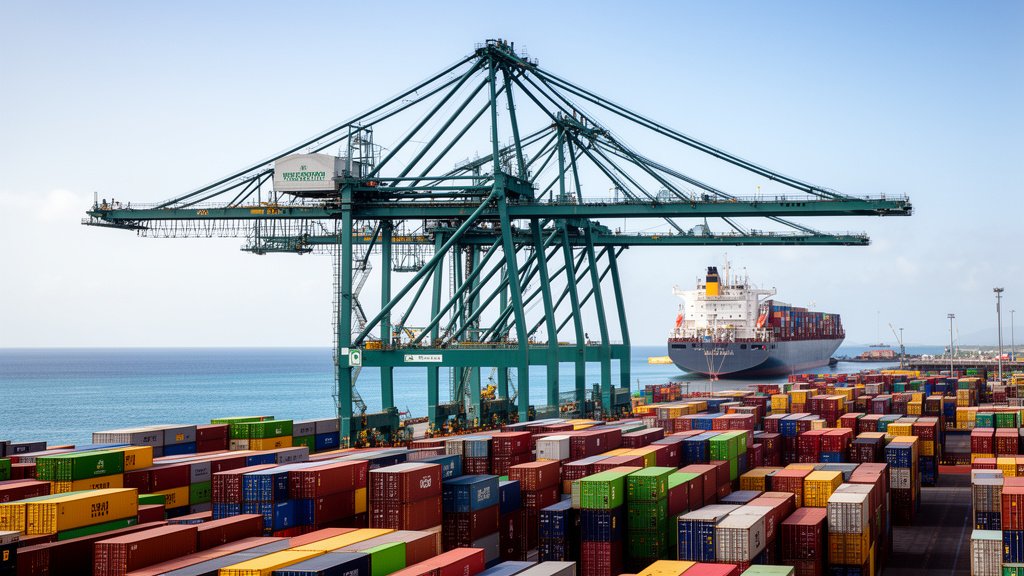
The Jamaican economy is currently navigating a complex aftermath of global supply chain volatility, centered on a 35% surge in shipping costs that continues to exert pressure on consumer prices. While global freight indices have shown signs of cooling following the erratic spikes observed during the post-pandemic recovery, the retail landscape in Jamaica has yet to experience a corresponding price correction. This economic phenomenon—often referred to as ‘sticky’ inflation—reveals a disconnect between international shipping rates and the localized cost of goods, creating a persistent burden for businesses and households alike.
Key Highlights
- The 35% Persistence: A verified 35% surge in shipping-related costs has fundamentally shifted the baseline for import-dependent pricing in Jamaica.
- The Pass-Through Effect: Unlike global freight indices, which are volatile, domestic prices remain elevated due to fixed operational costs, fuel surcharges, and local distribution overhead.
- Logistics Bottlenecks: Port efficiency at the Kingston Freeport Terminal remains a critical factor in determining how quickly price shocks dissipate, or whether they become embedded in the economy.
- Regulatory Outlook: Analysts are watching the Port Authority of Jamaica (PAJ) for policy interventions aimed at lowering the cost of doing business to stimulate competitive pricing.
The Unseen Mechanism of Imported Inflation
The narrative that ‘shipping costs are down’ is only half the story. While the Baltic Dry Index and other global benchmarks may suggest a cooling of freight rates, the Jamaican economy operates within a specific ecosystem of import dependency. The 35% shipping surge was not merely a temporary blip; it was a systemic shock that fundamentally altered the cost structure for local importers and wholesalers.
The Anatomy of the 35% Surge
The 35% figure represents the aggregate increase in total landed costs, which includes freight rates, bunker fuel surcharges, and the increased cost of local haulage. When shipping containers move from overseas ports to the Kingston Freeport, the price is not solely determined by the ocean freight rate. It is an accumulation of costs: handling fees at the point of origin, port charges in Jamaica, and the cost of the ‘last mile’ delivery. When the primary freight component surged by over a third, the shockwave rippled through every level of the supply chain. Because these costs are ‘sunk’ into the inventory before it even reaches the warehouse, businesses are hesitant to lower prices until they are certain the cost reduction is permanent and not a momentary dip in a volatile market.
Sticky Prices and Economic Friction
Economic ‘stickiness’ is the tendency for prices to resist downward movement even when external input costs drop. In Jamaica, this is exacerbated by high operational overhead. For a small or medium-sized enterprise (SME) in the manufacturing or retail sector, the margin is thin. If they dropped their prices immediately, they would risk insolvency should the shipping costs spike again. Furthermore, the ‘menu costs’—the physical cost of changing prices on retail shelves and updating digital catalogs—act as a barrier to rapid adjustment. Consequently, consumers feel the pain of the 35% surge immediately, but enjoy the relief of market corrections with a significant, agonizing lag.
The Infrastructure Challenge: Efficiency as a Price Control
A pivotal, though often overlooked, angle in this debate is the role of the Port Authority of Jamaica (PAJ) and the technological integration of the Kingston Freeport Terminal. In a modern logistics chain, efficiency is a discount. If the port can reduce ‘dwell time’—the time a container sits in the yard before being cleared—importers save money on demurrage and storage fees.
The Logistics Performance Index (LPI) Factor
Jamaica’s competitiveness in the Caribbean is tied directly to its LPI ranking. When shipping costs are high, the only way to mitigate the total landed cost for the consumer is to increase the speed and volume of goods processing. Investments in digital customs brokerage and automated crane operations are not just infrastructure upgrades; they are direct anti-inflationary measures. By smoothing the bottleneck at the port, the system can absorb external shocks, preventing the 35% surge from compounding into 50% or 60% increases at the retail level.
Future Predictions: Regional Resilience
Looking ahead, the Jamaican government and private sector players are likely to focus on three distinct strategies to blunt future shocks:
1. Regionalizing Supply Chains: Moving from a model of long-haul dependency to closer regional trade partnerships within the CARICOM bloc, reducing the reliance on volatile trans-oceanic routes.
2. Inventory Optimization: Utilizing AI-driven predictive analytics to manage inventory levels, ensuring that businesses can ride out short-term spikes without needing to pass immediate price increases to the consumer.
3. Diversification of Shipping Partners: Reducing dependency on a single carrier or alliance to gain more leverage in freight rate negotiations.
These strategies, while long-term, are essential. The 35% surge taught the Jamaican market that globalization is not a risk-free endeavor. Resilience in this context means decoupling the local price from global volatility through operational excellence and strategic sourcing.
FAQ: People Also Ask
Q: Why do shipping prices stay high if global news reports say they have dropped?
A: Global reports often cite ocean freight indices (the cost to move the container on the water). However, the ‘landed cost’ for an importer includes local handling, customs, fuel surcharges, and inland transportation. These local costs have remained high, keeping final retail prices elevated.
Q: How long does it take for shipping cost decreases to impact grocery store prices in Jamaica?
A: Historically, there is a 3-to-6-month lag. Importers operate on cycles; they must sell through existing, high-cost inventory before they can price new stock at lower rates, assuming they have negotiated lower freight contracts.
Q: Is the Port Authority of Jamaica doing anything to help?
A: The PAJ is actively investing in terminal modernization and technology to reduce dwell times. Faster processing directly reduces the auxiliary costs (demurrage/storage) that businesses pay, providing a marginal buffer against high freight rates.
Q: Are small businesses more affected than large retailers?
A: Yes. Larger retailers have better negotiating power with shipping lines and greater economies of scale to absorb or hedge against price fluctuations, whereas small businesses often pass these costs directly to the consumer to maintain cash flow.