
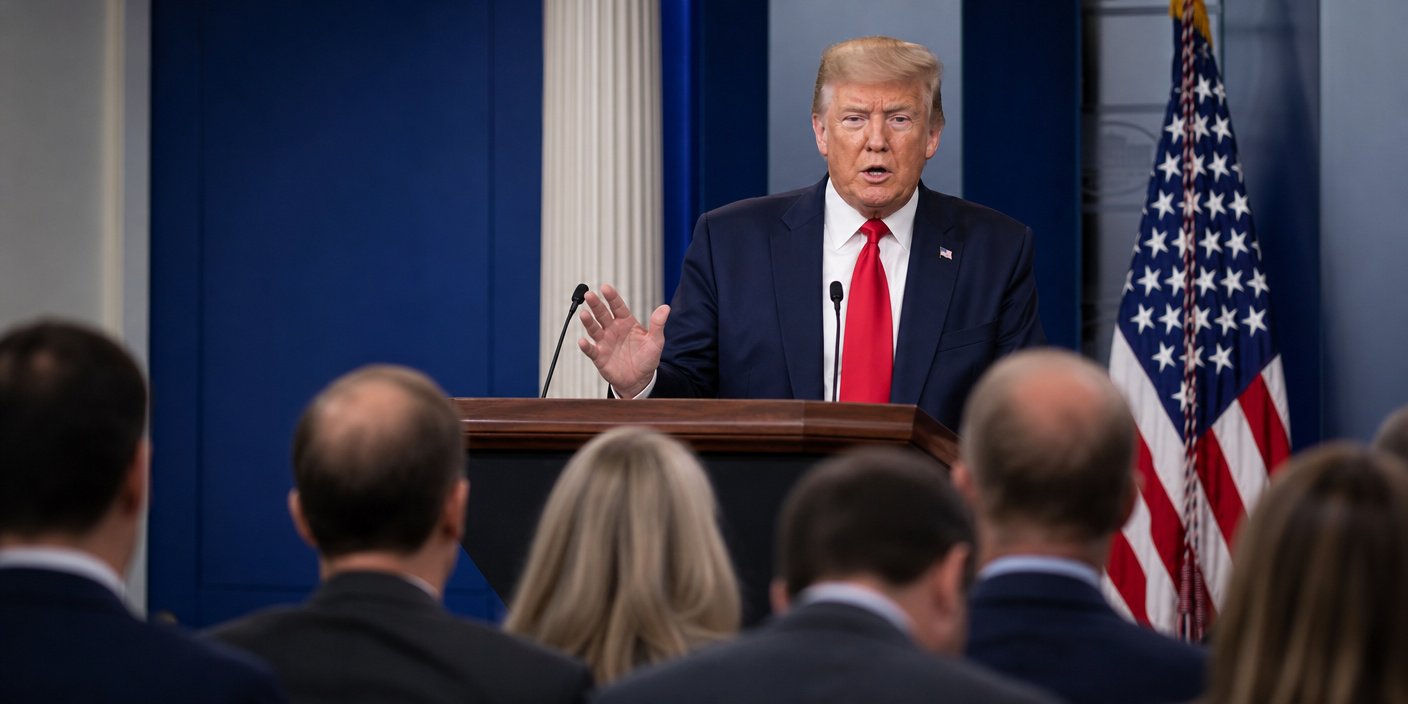
US President Donald Trump has officially announced a comprehensive agreement aimed at the phased disarmament of Hamas and the subsequent withdrawal of Israeli forces from the Gaza Strip. This development, characterized by administration officials as a critical step toward long-term stabilization, attempts to address the core security demands of the Israeli government while outlining a structured exit strategy for IDF personnel from the territory.
Key Highlights
- Phased Disarmament Protocol: A multi-stage plan requiring the verified decommissioning of Hamas’s military infrastructure and weaponry.
- Withdrawal Timeline: A structured, conditions-based withdrawal of Israeli Defense Forces from Gaza to be executed in tandem with security benchmarks.
- International Oversight: Implementation of an international monitoring body to verify compliance from both parties.
- Regional Stabilization Focus: The accord aims to pivot the region toward reconstruction and the establishment of a sustainable security architecture.
The Diplomatic Shift in Gaza: Understanding the New Accord
The announcement, delivered by President Trump, represents a significant deviation from previous conflict management strategies. By prioritizing a tangible ‘disarmament-for-withdrawal’ framework, the United States is attempting to bridge the deep-seated mistrust that has defined the conflict for decades. The core of this agreement hinges on a sequenced timeline, where tangible security gains—specifically the reduction of Hamas’s combat capabilities—trigger reciprocal moves by Israel to pull back its forces.
This strategy is designed to avoid a power vacuum, a primary concern for international observers. By linking the withdrawal to specific, verifiable actions rather than a fixed calendar date, the agreement attempts to maintain a security buffer until new administrative arrangements can be solidified. The role of the United States in this scenario is that of a guarantor, tasked with verifying that the phased drawdown does not expose the region to renewed violence.
The Mechanism of Disarmament
Central to the success of this agreement is the precise definition of ‘disarmament.’ According to early details, this involves the surrender of heavy weaponry, the destruction of underground tunnel networks, and the integration of security oversight committees that involve regional partners. The disarmament process is not intended to be a singular event but a series of benchmarks. Each benchmark must be certified by neutral monitors before the subsequent phase of Israeli withdrawal can commence.
This approach mirrors successful disarmament models utilized in other post-conflict scenarios, emphasizing the need for transparency. Critics of the plan have raised concerns regarding the verification methods; however, the administration has insisted that modern surveillance technology, combined with on-the-ground inspections, will be sufficient to ensure compliance. The efficacy of this mechanism will be tested in the initial phase, where Hamas is expected to demonstrate a cessation of military activity as a precursor to the first pullback of armored divisions.
Withdrawal Logistics and IDF Redeployment
For the Israeli government, the withdrawal represents a significant strategic pivot. The agreement requires a transition from an active combat footing to a defensive, monitor-based posture along the border. The withdrawal will occur in concentric circles, moving from densely populated areas first, followed by key logistical hubs, and finally the perimeter zones.
This phased retreat is calibrated to prevent the rapid re-infiltration of militant forces. By retaining control over specific observation points, the IDF remains in a position to re-intervene should the disarmament phase stall or be violated. This ‘reversibility’ clause is widely seen as the concession that made the Israeli government amenable to the deal. It allows for a political victory without sacrificing the immediate security of Israeli citizens living in proximity to the Gaza border.
Navigating the Geopolitical Ripple Effect
Beyond the immediate tactical implications, this agreement carries profound geopolitical weight. First, it directly impacts the normalization efforts between Israel and its Arab neighbors. By moving toward a resolution in Gaza, the administration believes it can reinvigorate broader regional cooperation, potentially paving the way for the next phase of the Abraham Accords.
Second, the agreement addresses the pressing need for humanitarian reconstruction. The cessation of major combat operations is a prerequisite for the flow of massive reconstruction aid. International NGOs and global powers have been waiting for a concrete security guarantee before committing the capital necessary to rebuild infrastructure, schools, and hospitals.
Finally, the political fallout within Hamas and Israeli domestic politics cannot be ignored. The deal puts pressure on the leadership of Hamas to justify the surrender of its military assets, a move that could catalyze internal shifts within the organization. Conversely, for the Israeli government, the deal is a balancing act between the desire for security and the political necessity of ending a prolonged conflict that has strained the national economy and military readiness. The coming weeks will be critical as both sides begin the arduous process of implementation.
FAQ: People Also Ask
Q: What is the primary incentive for Hamas to disarm under this agreement?
A: The agreement ties disarmament to the withdrawal of Israeli forces and the subsequent lifting of blockades, which aims to facilitate the flow of humanitarian aid and economic reconstruction funds into the Gaza Strip.
Q: Who will monitor the compliance of this agreement?
A: The framework relies on an international monitoring body, likely comprised of regional stakeholders and neutral third-party observers, to verify the destruction of weapons and the movement of military forces.
Q: Does this agreement address the long-term governance of Gaza?
A: While the current focus is on security and disarmament, the agreement includes a roadmap for a transition to a new administrative authority, which is intended to follow the successful completion of the withdrawal phases.
Q: What happens if one side violates the agreement during the phased process?
A: The agreement includes ‘reversibility clauses’ which allow for the cessation of the withdrawal process and the re-initiation of security operations should either party fail to meet their agreed-upon benchmarks.