
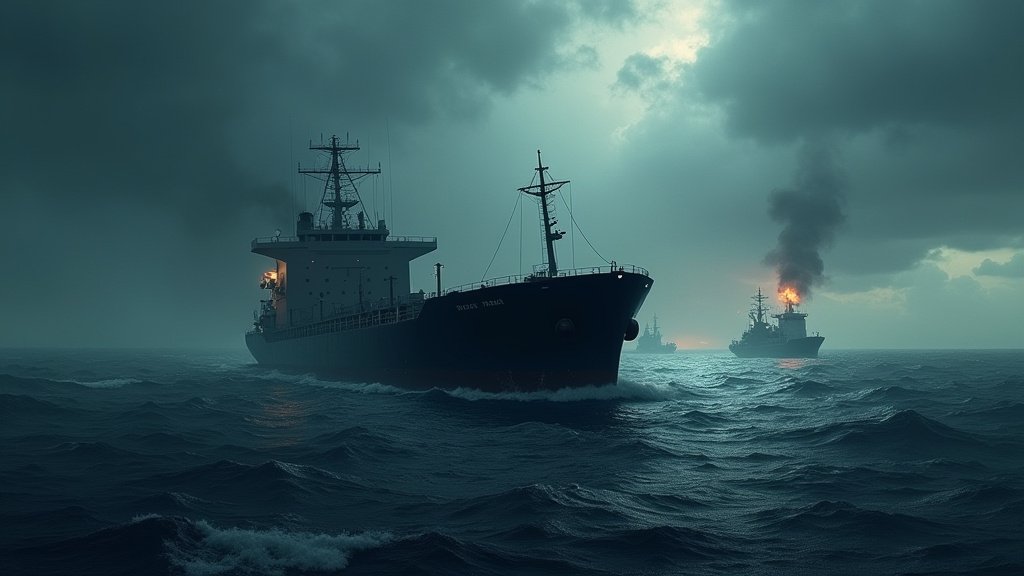
US Intensifies Strikes on Iran’s Coast Amid Strait of Hormuz Tensions
Following President Donald Trump’s declaration on Wednesday of the collapse of a preliminary peace agreement, the U.S. and Iran have engaged in renewed airstrikes. The U.S. military has significantly increased its operations, hitting 90 targets overnight, primarily along Iran’s coastline adjacent to the critical Strait of Hormuz. This surge in military action comes as a response to what the U.S. describes as Iranian attacks on commercial shipping in the vital waterway.
Escalation Follows Collapse of Peace Agreement
The fragile peace, which was marked by a memorandum of understanding signed on June 17, has crumbled following a series of escalating actions by both nations. President Trump’s assertion that the ceasefire was “over” signaled a return to direct confrontation. The U.S. strikes are reportedly aimed at degrading Iran’s capability to threaten commercial shipping and innocent mariners in the Strait of Hormuz. Targets included air defense systems, coastal surveillance assets, missile and drone storage sites, and naval capabilities.
Iran’s Retaliation and Regional Impact
In response to the U.S. strikes, Iran has retaliated with barrages of drones and missiles targeting U.S. military sites in partner countries in the Persian Gulf region, including Bahrain, Kuwait, and Qatar, as well as military sites in Jordan. These tit-for-tat exchanges have raised global concerns about the stability of the region and the security of international shipping lanes. The Strait of Hormuz, through which a significant portion of the world’s oil and natural gas passes, has become a focal point of the renewed conflict.
Economic and Geopolitical Ramifications
The intensification of strikes has had a notable impact on global energy markets, causing a temporary spike in crude oil prices. Reports indicate that shipping in the Strait of Hormuz has come to a near standstill, stranding thousands of seafarers. International bodies, including the UN International Maritime Organization (IMO), have called for restraint and de-escalation, highlighting the catastrophic consequences a full-scale war could have on the global economy and regional peace.
Key Entities Involved
The primary entities involved in this escalating conflict are the United States, led by President Donald Trump, and Iran, whose leadership has vowed retaliation. U.S. Central Command (CENTCOM) has been instrumental in directing and detailing the U.S. military operations. The Strait of Hormuz itself is a critical geographical entity central to the ongoing dispute. The Islamic Revolutionary Guard Corps (IRGC) is also mentioned as a target of U.S. strikes.
Secondary Angles
Historical Context: This escalation echoes previous periods of heightened tension and conflict in the region, particularly concerning control over vital shipping lanes. The history of U.S.-Iran relations is marked by periods of proxy conflict and direct confrontation, making the current situation a continuation of long-standing geopolitical rivalries.
Impact on Global Trade: The Strait of Hormuz is a chokepoint for global energy supplies, with approximately 20% of the world’s oil passing through it before the war. Disruptions to this flow have immediate and significant consequences for global trade, energy prices, and economic stability worldwide. The current standstill threatens to exacerbate these issues.
Diplomatic Efforts and Future Outlook: The collapse of the peace agreement and the resumption of strikes cast a shadow over future diplomatic efforts. The effectiveness of future negotiations will likely depend on the ability of both sides to de-escalate and find common ground, particularly regarding maritime security and regional influence. The threat of Iran altering its nuclear doctrine adds another layer of complexity to future diplomatic considerations.
FAQ: People Also Ask
What led to the current U.S. and Iran airstrikes?
The current airstrikes were triggered by President Donald Trump’s declaration that a preliminary peace agreement between the U.S. and Iran had collapsed, following alleged Iranian attacks on commercial vessels in the Strait of Hormuz. This led to renewed U.S. strikes on Iranian targets and subsequent Iranian retaliation.
What is the significance of the Strait of Hormuz?
The Strait of Hormuz is a vital waterway that connects the Persian Gulf to the open ocean. It is a critical chokepoint for global energy shipments, with a significant portion of the world’s oil and natural gas passing through it daily. Its strategic importance makes it a frequent point of contention.
What has been the economic impact of these hostilities?
The renewed hostilities have unsettled energy markets, causing a temporary spike in crude oil prices. Shipping in the Strait of Hormuz has been severely disrupted, leading to concerns about global energy supply and potentially higher prices for consumers. Thousands of seafarers have also been stranded.
Has the preliminary peace agreement completely collapsed?
President Donald Trump declared the preliminary peace agreement “over” on Wednesday, citing Iranian attacks on ships as the reason. This declaration effectively ended the fragile ceasefire and resumed direct military confrontation between the U.S. and Iran.
What is Iran’s response to the intensified U.S. strikes?
Iran has retaliated by launching drones and missiles at U.S. military targets in the Persian Gulf region and in Jordan. The Iranian leadership has also threatened “grave consequences” for the U.S., indicating a willingness to escalate further if necessary.