
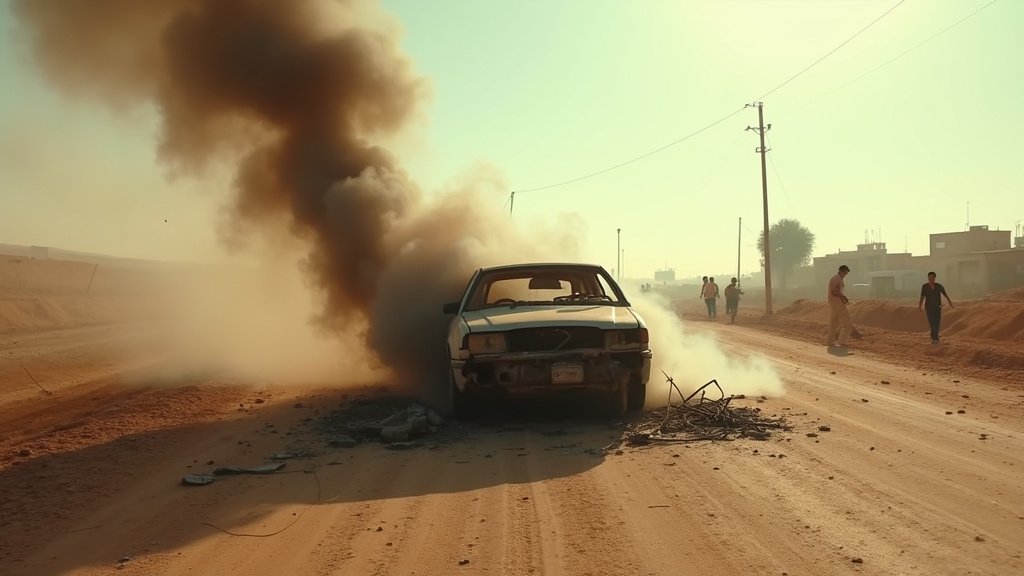
In a stark breach of a nearly year-old ceasefire, an Israeli airstrike Lebanon targeted a civilian vehicle in southern Lebanon on Monday, November 10, 2025, leaving several people injured. The attack near Baisariyah in the Sidon district represents the latest in a series of violations that have severely strained the hard-won truce brokered in November 2024, underscoring the volatile nature of the Hezbollah Israeli conflict.
The Latest Israeli Airstrike Lebanon and Mounting Casualties
According to Lebanese media reports, an Israeli drone struck a car on the main road of Al-Baysariyah town on Monday. While immediate details on the number and condition of the injured were scarce, the incident immediately raised concerns about escalating tensions and the potential for increased civilian casualties Lebanon. This Israeli airstrike Lebanon followed closely on the heels of two other fatalities reported from Israeli strikes in southern Lebanon just a day prior, exposing a continued disregard for the cessation of hostilities. On Sunday, one person was killed in a strike between Al-Sawwaneh and Khirbet Selm in the Bint Jbeil area, and another died when an Israeli drone fired missiles at a car on the Houmine al-Fawqa–Hamila road in Nabatieh’s Iqlim al-Tuffah region. Lebanese state news agency NNA reported continued Israeli drone activity over several regions, flying at medium and low altitudes and spreading panic among civilians already reeling from months of aggression and these frequent Lebanon ceasefire violations.
Ceasefire Under Severe Strain: The Impact of an Israeli Airstrike Lebanon
The November 27, 2024, ceasefire agreement, brokered by the United States and France, aimed to halt hostilities and mandated Israeli withdrawal from southern Lebanon while Hezbollah forces were to move north of the Litani River. However, the agreement has been under constant pressure, with reports indicating ongoing Israeli operations targeting alleged Hezbollah military infrastructure and rearmament efforts. Despite the truce, Israel maintains a military presence at several border outposts and has conducted numerous strikes, which it claims are in response to immediate threats and violations of the ceasefire terms. The ceasefire, which was initially for 60 days, has seen continued Lebanon ceasefire violations, with France reporting dozens of Israeli transgressions and the UN Interim Force in Lebanon (UNIFIL) documenting multiple airstrikes as clear violations of UN Security Council Resolution 1701, a recurring issue following each Israeli airstrike Lebanon.
International Condemnation and Conflicting Narratives on Israeli Airstrike Lebanon
International bodies have voiced strong condemnation of the repeated Israeli strikes. The European Union has urged Israel to cease all actions violating UN Resolution 1701 and the ceasefire agreement. EU foreign affairs spokesperson Anouar El Anouni stressed the need for all parties to preserve the ceasefire and the progress achieved so far. The UN Interim Force in Lebanon (UNIFIL) also condemned recent airstrikes, calling them “clear violations” of Resolution 1701 and warning that such actions threaten civilian safety and undermine diplomatic efforts amid the ongoing Hezbollah Israeli conflict.
Lebanese President Joseph Aoun has criticized the Israeli strikes, labeling them “fully fledged crimes” and violations of international humanitarian law. He emphasized that Lebanon’s openness to peaceful negotiation is met with intensified Israeli aggression, stating that “every time Lebanon expresses its openness to peaceful negotiations… Israel intensifies its aggression”. The Lebanese army has accused Israel of seeking to “undermine Lebanon’s stability” and hinder its deployment in the south. In contrast, the Israeli military asserts that its operations target Hezbollah’s “terrorist infrastructure” and “military reconstruction activities,” citing the group’s alleged efforts to rebuild its capabilities and use civilian areas as cover, a narrative often following an Israeli airstrike Lebanon.
Underlying Tensions and Future Stability following the Israeli Airstrike Lebanon
The ongoing exchange of strikes, despite the ceasefire, underscores the deep-seated tensions and the fragile security situation along the Lebanon-Israel border, a key aspect of the Middle East tensions. The conflict, which escalated into a full-scale offensive in September 2024 after beginning in October 2023, has resulted in significant civilian casualties Lebanon, with reports indicating thousands killed and tens of thousands injured in Lebanon. The continued Israeli operations, coupled with Lebanon’s efforts to assert state control over weapons and Hezbollah’s refusal to disarm, create a volatile environment, often punctuated by a drone attack southern Lebanon. The world watches closely as these violations test the durability of the November 2024 ceasefire and raise concerns about potential wider escalation in the region. This news underscores the persistent challenges to achieving lasting peace and stability in the Middle East, with each Israeli airstrike Lebanon adding to the precarious situation.