
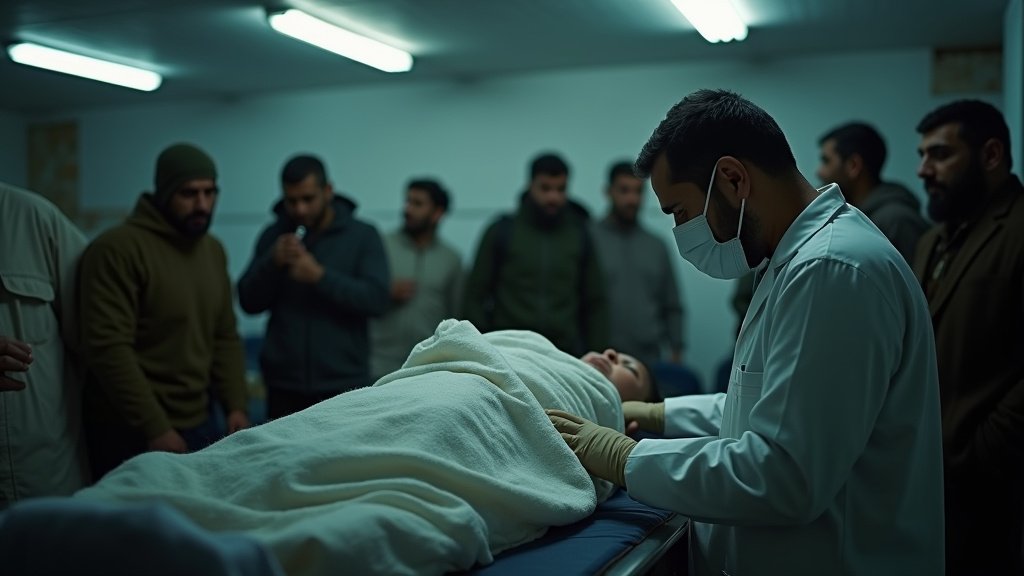
The **Israel Palestine Exchange** of bodies is a complex and deeply sensitive aspect of the ongoing situation. Israel returned the bodies of 15 Palestinians to Gaza on Friday, officials at Nasser hospital in Khan Younis reported. This latest transfer of remains is part of a fragile U.S.-brokered ceasefire agreement and follows the handover of an Israeli hostage’s body by militants late Thursday, highlighting the intricate nature of any **Israel Palestine Exchange**.
The Reciprocal Exchange in the Israel Palestine Exchange
The bodies were delivered to Gaza on Friday, November 14, 2025, in a move seen as a continuation of the complex exchanges central to the current truce. This action was directly linked to the prior evening’s event, where militants handed over the body of Meny Godard, identified as one of the last remaining Israeli hostages taken during the October 7, 2023 attacks. Godard, abducted from Kibbutz Be’eri in southern Israel, was killed alongside his wife Ayelet during the initial assault, underscoring the grim reality of this **Israel Palestine Exchange**.
The framework of the U.S.-brokered ceasefire stipulates a reciprocal exchange: for each Israeli hostage whose remains are returned from Gaza, Israel releases the bodies of 15 Palestinians. This arrangement has been a significant component of the initial phase of the agreement, defining a core element of the **Israel Palestine Exchange**. Since the ceasefire began on October 10, 2025, the remains of 25 Israeli hostages have been returned to Israel, with three more believed to still be in Gaza. Prior to this latest exchange, Hamas had also returned 20 living hostages on October 13, a part of the broader context surrounding the **Israel Palestine Exchange**.
Broader Figures and Ongoing Challenges in the Israel Palestine Exchange
According to Gaza Health Ministry officials, the total number of Palestinian bodies received so far through these exchanges stands at 330, though only 95 have been formally identified. Previous reports indicated figures such as 285, 270, or 315 bodies received, all part of the difficult **Israel Palestine Exchange**. The process of identifying these remains has been severely hampered by a lack of essential resources, including DNA testing kits, and the advanced decomposition of some bodies, contributing to the **humanitarian challenges**.
The fragile nature of the ceasefire is underscored by mutual accusations of violations between Israel and Hamas. Israeli officials have alleged that Hamas has at times handed over partial remains or staged the discovery of bodies. Conversely, Hamas has accused Israel of opening fire on civilians and restricting the flow of humanitarian aid into Gaza, impacting the potential for a successful **ceasefire agreement** and further complicating the **Israel Gaza conflict**.
Compounding the difficulties, doctors in Gaza have reported that many of the returned Palestinian bodies show disturbing signs of torture and execution, including blindfolds, cuffed hands, and gunshot wounds to the head. These harrowing accounts add another layer of distress to families struggling with the uncertainty and grief of identifying their loved ones, a tragic consequence of the ongoing **Israel Gaza conflict** and the nature of the **hostage exchange**.
A Strained Path Forward for the Israel Palestine Exchange
The exchanges of bodies, while fulfilling a key aspect of the ceasefire terms, occur against a backdrop of widespread devastation and ongoing conflict in the Gaza Strip. The process highlights the profound **humanitarian challenges** and the deep-seated distrust that persist between the parties, making any **reciprocal exchange** incredibly difficult.
As the world watches, these grim exchanges serve as a stark reminder of the human cost of the conflict. The continued implementation of these provisions, despite the immense difficulties and accusations, represents a complex and often agonizing step in the broader, challenging path toward any lasting resolution or de-escalation in the region. The identification process, and the very conditions under which these **Palestinian bodies** are returned, remain critical points of concern for international observers, the affected families, and the pursuit of **conflict resolution**.