
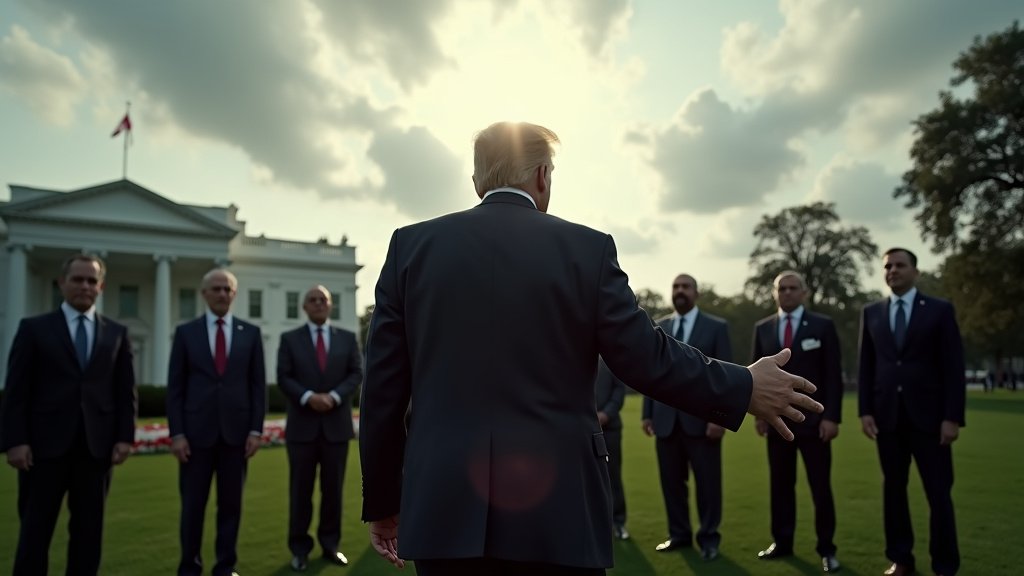
WASHINGTON D.C. – President Donald Trump announced Thursday that he expects a US-coordinated Gaza Stabilization Force to be deployed on the ground in Gaza “very soon,” signaling a significant step in his administration’s plan to bring an end to the protracted Gaza conflict. The declaration was made during a White House gathering with Central Asian leaders, where Trump characterized the current situation in Gaza as “working out very well” and indicated that numerous countries have volunteered to contribute troops to the multinational troop deployment for the Gaza Stabilization Force.
UN Security Council Draft for Gaza Stabilization Force Authorization
The White House has been actively pursuing diplomatic avenues to solidify this plan, circulating a draft resolution within the United Nations Security Council. This draft seeks authorization for an international Gaza stabilization force to operate in Gaza for at least two years, aiming to ensure the territory’s demilitarization and the decommissioning of weapons from non-state armed groups. The proposed Gaza Stabilization Force would be tasked with various critical duties, including training and supporting vetted Palestinian police forces, securing border areas, preventing weapons smuggling, protecting civilians, and ensuring the unimpeded flow of Gaza humanitarian aid, as part of a comprehensive Middle East peace plan.
Washington’s UN envoy, Mike Waltz, has shared the draft resolution with the 10 elected members of the Security Council, as well as with key regional partners such as Egypt, Qatar, Turkey, the United Arab Emirates, and Saudi Arabia. While a vote has not yet been scheduled, the circulation of the draft text is seen as an early template for extensive negotiations among member states and international partners regarding this vital Gaza Stabilization Force.
Complexities of Troop Contributions and Mandate for the Gaza Stabilization Force
The composition of the multinational force is expected to include troops from countries such as Egypt, Qatar, Turkey, and the United Arab Emirates, among others expressing interest in an international stabilization force. However, many nations have indicated that UN backing is a prerequisite for their troop contributions to the Gaza Stabilization Force. A significant point of contention remains the mandate and leadership of the force, with reports suggesting that Israel has not been fully consulted on the UN Security Council draft. Some countries, like Turkey, have faced objections from Israel regarding their potential participation in the proposed Gaza Stabilization Force.
Background: A Two-Year Conflict and Fragile Ceasefire for Gaza Conflict Resolution
The announcement comes amidst a conflict that has lasted for two years, following the October 7, 2023, attacks by Hamas on Israel. Trump’s administration has been instrumental in brokering a fragile ceasefire that took effect on October 10, 2025, as part of a broader 20-point Middle East peace plan. This plan encompasses immediate ceasefires, hostage and prisoner exchanges, Gaza humanitarian aid, temporary governance, and the eventual reconstruction and potential Palestinian self-determination, all crucial elements for the success of the Gaza Stabilization Force.
While the ceasefire has seen exchanges of hostages for prisoners, with Hamas releasing 20 living hostages and the remains of 22 others in exchange for nearly 2,000 Palestinian prisoners, the humanitarian crisis in Gaza has remained severe. Official reports indicate that over 67,000 Palestinians have been killed and more than 169,000 injured since the Israel Hamas conflict began in October 2023. The United Nations has also continued to call on Israel to halt demolition orders against Palestinian homes in the occupied West Bank, highlighting ongoing tensions and humanitarian concerns that the Gaza Stabilization Force aims to address. The United Nations Security Council draft is a key component of this effort.
International Efforts and Regional Developments for the Gaza Stabilization Force
The United Arab Emirates has been a leading humanitarian donor, providing billions of dollars in aid to Gaza and playing a significant role in relief operations. Meanwhile, diplomatic efforts continue to address other critical issues, including negotiations for the safe passage of Hamas fighters who may be trapped in certain zones, with proposals involving their surrender of arms in exchange for passage to other areas of the enclave, a crucial step for the success of the Gaza Stabilization Force and for Gaza conflict resolution.
Beyond the Middle East, other global news includes ongoing intense fighting in Ukraine, particularly around the strategic city of Pokrovsk, where Russia is employing new infiltration tactics. In India, the first phase of elections in the state of Bihar has commenced, testing Prime Minister Modi’s popularity and the strength of his alliance. These concurrent world events underscore a period of significant geopolitical activity and shifting dynamics across the global stage, all while the international community focuses on the deployment of the Gaza Stabilization Force and the broader Middle East peace plan.